Showing posts with label FREEBIE. Show all posts

Pigeon Math Story Problems-FREEBIE

Jan 4, 2020


I am all about themed story problem units!  They engage students and keep them invested in the story being told.  So when I read Pigeon Math by Asia Citro, I knew that it was a great springboard for a new themed unit.

pigeon math story problems

The book introduces story problems by adding and subtracting pigeons in and out of the story.  The characters have silly faces and funny situations, so it will get students invested and interested.  Once this is read, I would dive right into students solving problems with birds on and off a telephone wire.

Student Party Planning to Creatively Analyze Book Characters

Oct 24, 2019


student party planning to creatively analyze book characters

For the past several years, Otis has been a well-loved name in our classroom.  If you have never met him, Otis is a kind-hearted, loving, red tractor that makes several new friends throughout the series.  I have written about this book throughout the years, as he has been used during theme and metacognition lessons within our classroom.  But this year proves to be just a little different.  Because this year...Otis turns 10!  And we are ready to celebrate.
 

Putting It All Together: A Winter Giveaway

Dec 6, 2018

Can you believe winter is almost here and 2018 is wrapping up.  It amazes me each year how quickly it goes.  I love the end of the year because it is a time to reflect and grow. 
One reflection you may make at this time of year, is the gaps that are closing or growing between some of your students. Where do you need to push forward and where do you need to back up a bit?

Currently, I have students that are well on their way to becoming more fluent readers, while others are continuing to struggle with letters and sounds.  It is time to push forward for some and pause for more explicit teaching for others.


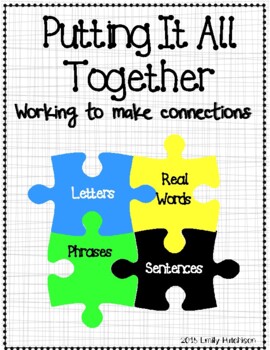
Some students do not quite know the difference between a letter, word, and sentence (this is true for many of our kindergartners).  This Powerpoint visually shows students a letter.  How the letters make up words and the words make up sentences.   I made is a short video to show you a small part of the powerpoint. Click on the slide image to purchase (Free on 12/8/18-12/9/18 only).


My first graders know the difference between letters, words, and sentences, but may still have trouble seeing how they are interconnected. I wanted needed my students to really SEE the connections.  Out of that need...this was created.  It helps students to "put it all together."

This particular version is a review sheet of short vowels.  Students have the opportunity to read words with short vowel sounds, while also engaging in a short winter story.

When looking at this sheet.  You can see that it begins with letter sounds.  Students read each letter sound. 

The second part illustrates that the letters from the first part make up words.  Blend the words with students.

These words can then be found in phrases.  (This is a great time to talk about why we read in phrases and how it can help us to sound like fluent readers).

Finally, these phrases (which include words,  that are made from sounds) form sentences, paragraphs, and stories.

Every letter, word, and phrase connects to the winter story.

There are many different ways to use this sheet.   One way to use this sheet may be to take one colored marker and highlight all the letters for one particular word (for example: "hats").  Then highlight the word "hats" in the second part.  Highlight the phrase that "hats" is found in.  Finally, find the sentence with the word "hats" and highlight it.  This illustrates to the students the connection of the letters all the way down to the story.

This particular student illustrates another way to "put it all together."  She was working on short vowel sounds in words.  She highlighted the short vowels and looked at how the short vowel phrases could be found in the story.


While each student has their own individual needs, this sheet may be used differently in your classroom; however, the ultimate goal is for them to see how sounds, words, phrases, and sentences all build off of each other.

I hope that you can use these with your students.  You can grab a free copy by clicking on the winter edition image below.  If you are looking for more "focused" sheets, you can click on the second image.  This pack has a different phonics skill per sheet.  It is a great way to explicitly teach specific skills.


FREEBIE Putting it Together: letters, words, and sentencesPutting it all together: letters, words, and sentences

Not ready to use this?  Just pin it for later!


 Thanks for checking out these products.  Although this is just a stepping stone, our ultimate goal is to always get books into the hands of our students.  I love to support any local bookstores that I can, whether it be in my hometown or a city I'm visiting.  Please enter the giveaway below for your chance to win $25 to Half Price Books (www.hpb.com).


a Rafflecopter giveaway

For a chance at more $25 giftcards and free resources, check out the sites below!


Opinion Writing with Miss Turie's Magic Creatures

Sep 30, 2018

I have seem many lessons out there on opinion writing about pets.  There are some great mentor texts to use that support students in this writing process
  •  The Perfect Pet by Margie Palatini
  • Cats Vs. Dogs by Elizabeth Carney
  • One Word for Sophia by Jim Averbeck
  • Can I Have A Stegosaurus, Mom? Can I Please? 
  • I Wanna Iguana by Karen Orloff
 But I recently had one sent to me from Innovation Press.

https://www.amazon.com/Miss-Turies-Magic-Creatures-Keller/dp/1943147418

Miss Turie owns a pet shop and she has one guarantee: to find the right pet for you!  A young boy comes in to find his perfect pet and Miss Turie shows him around.  Each creature is mythical and magical, but not right for him.
This book is colorful and fun.  It is full of speech bubbles and curious magic.  One of my favorite parts about this book are the last four pages.  One these pages, the author shares a little history about each of the mythical creatures within the story.  This lends itself really well to opinion writing :)

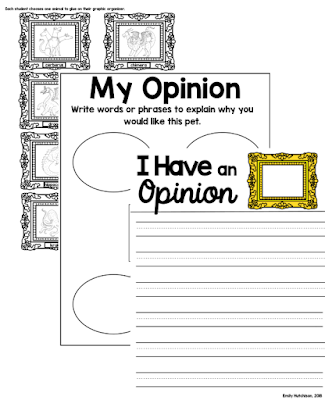
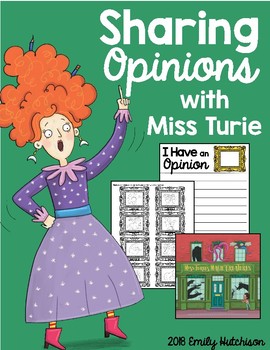
This freebie includes images of each "pet" within this book.  Students pick the pet that would be best for them.  Then they explain why.  There are differentiated versions of the webs and paper choices.

https://www.teacherspayteachers.com/Product/Miss-Turies-Magic-Creatures-Opinion-Writing-4082174


If you would like to check out this book, just click on the image above.  And grab this companion product (FREEBIE) by clicking on the image below!  Hope you enjoy the books!

https://www.teacherspayteachers.com/Product/Miss-Turies-Magic-Creatures-Opinion-Writing-4082174

Literacy at Home

Sep 27, 2017

We know literacy at home is important.  To be successful at anything in our lives, we need practice.  And reading is no different.  For our students to become stronger readers, critical thinkers, and problem solvers, they must be able to practice those skills during school hours and outside of those hours.


There are so many fantastic ideas out there to help engage families in literacy, such as: events at the school, game nights, conferences, open houses, curriculum nights, and newsletters.  Many teachers send home books bags or homework.  All of these decisions are a way to engage families in educational conversations with their children.

Then I had my own children.

Many things I do with my girls has an educational spin.  Literacy is ever-present in our daily home.  Since they were very little, my girls have carried around the grocery list and checked off the items we put into our cart. Even before they were able to talk, I was pointing out words and colors on the trucks that passed by our car.  As they got older, we were reading the trucks and bulletin boards or discussing the meaning behind the lyrics that we were singing.  None of these ideas are ground breaking.

But it made me wonder...what are my students doing at home that are literacy based activities?  Do all families think to discuss the grocery list?  Do families collect as many acorns as they possibly can during a walk and then count them by ones, twos, or tens?  Is this just what you do with your own children naturally or does it come from my educational background?

So I asked around.

And what I found is that it is probably both.  Each family is unique and provides different learning experiences for their children based on their comfort level.  But there may be some things I do with my kids, that do come from my background of constant reading of educational blogs and teacher books.

This got me thinking...

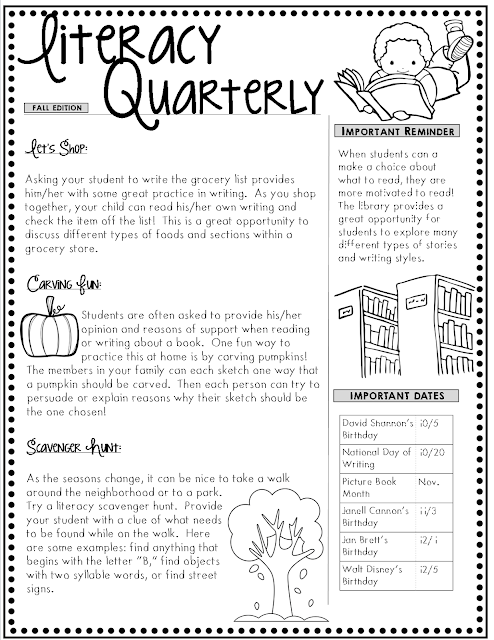
I want literacy to be enjoyable for my students and their families.  I know for some homework and nightly reading can bring back some unpleasant experiences for parents that struggled to read.  So to help promote some positive experiences, I decided to create a quarterly newsletter.  It is not meant to replace reading, homework, literacy nights, or anything else.  I simply wanted to provide user friendly fun for families.

 Fun literacy activities for families

There is one newsletter for each season.  Three activities are introduced.  There are some "important dates."  Most of these are authors' birthdays or national literacy days.

I would love to get your thoughts.  Do you think families would appreciate some fun ideas to incorporate literacy into their everyday lives?  If you want to check out all of the sheets, just click on the image above.  It is FREE!

Em

Guided Reading Supports and Supplements

Mar 28, 2017

This year we made a lot of changes to our RtI process.  I shared many of them at the beginning of this school year.  And watching how they all played out has been amazing.  But that needs a whole other post.  Today, I want to focus on just one of those changes: LLI or Leveled Literacy Intervention by Fountas and Pinnell.

This has been an absolute game changer at my school, when it comes to intervening with students that are reading below grade level.  First of all, we call it "book club" in my building.  So, of course, every single student wants to be in LLI! We have been able to service many kids with the intervention this year and when a student "graduates" out, they are so sad!  Some of them have even decided to start their own book clubs at lunch.  This is a sign of a good program, to me.
Second, the power of having only three students in a reading group...wow!! I am able to evaluate, analyze, prompt, and teach much more effectively. 
And third, the books.  My students love LOVE the books from LLI.  There are characters that they literally cheer for when I pull out the book for the day.

But, like anything in education, one size will never (and should never) fit all.  I have some students that continue to struggle with knowing their letters and sounds; therefore, I have to infuse more instruction on letters/sounds into my daily lesson routine with them. And my analysis/reflection of my own teaching needed to be strengthened.

Here are some free resources to help you supplement letter/sound knowledge and guided reading notes.

(Note: this can be the case in any guided reading group, not just LLI, and that is why I titled this post "guided reading supports.")

Letter/Sound Correspondence
 
After introducing each letter over a period of time with multi-sensory techniques, my students just needed some repetitive practice that I could complete quickly each day.  Once we complete this quick review, we utilize the letter/sound knowledge through reading and writing everyday.


This format is something that I found on a blog years and years ago.  I have no idea from which blog though.  If you know who this came from, I would love for you to share that information!!  The format has worked well for me but I needed it to fit my LLI needs. So I changed the images to match my needs.  Here's how I use it...The students must touch the images and letters as we chorally recite the page together.  This works on one to one correspondence, directionality, and (not to mention) that they need to look at the letters in order to remember them.  For the letter b, this is what we would chorally say together, " bear, bear, /b/, /b/, b."  The last b is highlighted because we say the letter name instead of sound.

What I have found, is that the students utilize this chart information when I ask them to look for words with a certain beginning sound, when we are writing, and when they are trying to sound out a word.  Their letter/sound knowledge has also increased since I began using it each day.

 Reading Analysis/Notes

 It took me a few years (yes, I am sorry to admit it) to feel like I had running records under control in my guided reading groups.  Fitting everything in has always been a tricky thing.  LLI has the reading records embedded into your instructional time.  Whether it is an LLI group or my regular guided reading groups, I love listening to them one on one and learning what they can do independently and what they need to work on.  

LLI has three categories for a teacher's response when listening to a student read or write: teach, prompt, and reinforce.  "Teach" means that I am having to teach or reteach a skill to a student.  For example, they have not learned a particular vowel team; therefore, I am explaining and teaching that new vowel team to them so that they can decode the word that they are stuck on.  "Prompt" means that I am prompting a student to use a strategy that has been previously taught but that the student is not doing independently, yet.  "Reinforce" means I am providing positive feedback to a student that used a strategy correctly.

This is not necessarily new knowledge.  I think as teachers we just do those three things: teach, prompt, and reinforce.  But what I realized as the year has progressed is that I am not looking for patterns in my teaching and prompting of individual students.   If I wrote down my prompts, would I find patterns?  For example, am I prompting the same student over and over again for VCE words?  Do I actually need to be reteaching this skill, instead of prompting for it?

So I decided to write these things down to look for patterns.  As students are reading independently from their LLI book, I am quickly using code to write down what I teach, prompt, or reinforce.  Then I can use the information to look for patterns over a weeks time and guide my instruction for the following week or lesson.


The prompting guide from Fountas and Pinnell breaks the prompts into groups.  I used these groups to create my codes (which are at the bottom of the sheet).  The codes help me to take notes quickly.  Here is an example of a student.  I typed the notes in red for easier reading.


 When analyzing these notes, I can see that I need to continue to work with this student on vowel sounds.  He continues to struggles with this visual information when solving unknown words in his reading and writing.

When it comes to LLI and my guided reading groups, I always have room to grow.  These are two ways that I have supplemented my instruction but I will be continuing my quest for more ways to strengthen what I do.  If you would like to try these out, just click on the images below to grab them.


https://drive.google.com/file/d/0B3eyEJCd5J5kSDEyeDRDa0I0Y1U/view?usp=sharinghttps://drive.google.com/file/d/0B3eyEJCd5J5kYmR3MnVBbDdBakU/view?usp=sharing

 Thanks!
Em

A Mentor Text to Warm Up Your Winter

Jan 1, 2017


Happy New Year!  2017 is here and what better way to kick it off then to try out some new mentor texts in your classroom!  Today you can click through and find some lessons to help you "warm up" those long winter days.  I am excited to share a new favorite book, Bunny Slopes, by Claudia Rudea.

 This text is perfect for the PreK-1st grade age range (although, my second grade daughter really enjoyed reading it, as well).  The main character is a bunny and he is eager to go skiing; however, in order to do so, he asks the reader for some help.  In order for the bunny to go skiing, the reader must shake, tilt, and turn the book.  In the end, the reader is going on an adventure right along with the bunny!  It is simple, sweet, and (the best part) interactive.

Students make an interactive verb book

For this text to work, students must actually interact with the book and the characters.  What better way to introduce verbs!  A verb is an action and to make this type of book work, students must preform an action.  The lesson outlined below will work for a variety of classrooms, depending on their level of need.  Some students may be ready to discuss the different shades of meaning with verbs, while other classrooms may just be learning what a verb is.

Honestly, I would jump right into this book without an introduction.  It is such a fun book and I want the students to just enjoy it the first time that it is read without looking for verbs or predicting what is going to happen.  Just let them enjoy it the first time around.  But after that initial read, then the teaching can begin with one question, "What did the bunny ask us to do?"  By asking this one question, we can begin to help the students define the what a verb is.  It may be helpful to write the definition and the words "shake, tilt, and turn" on chart paper.

Then it is time for the next read.  But this time students need to listen for verbs, or action words.  When the verbs are found during the second or third read, they can be added to the chart paper.  But the students can also continue to interact with the book.  This brings the verbs to life and helps them to understand that they are action words.

Only a few verbs are used within Bunny Slopes; however, after reading the book the students can be invited to come up with some of their own action words to add to the list.  Students can even act out these words.  I always like to provide some non-examples, as well, to help them really distinguish between what is and is not a verb.

To help students have a better understanding of how to use verbs, they can create their own book.  And the best part...the readers will interact with the book using the verbs that your students choose!  This book can be used in several different ways (depending on student need): shared writing, class book, or individual books.  Here's how it works as an individual book...
Each students receives a four page book, a title page, and a bunny.  They must complete each page by writing the word "bunny" and one verb to explain what the bunny is doing.

a mentor text lesson

Then the character must be cut out and the title page constructed.  To make the title page, students need to cut out the image, fold, and glue the sides down.  This creates a "pocket" for the bunny to fit into.

a mentor text lesson

Once the book is complete, the reader can use the bunny to "act out" the verbs in the text.  It becomes an interact book!

A mentor text lesson

When choosing the scenes for this book, I had "shades of meaning" in mind.  Students are going to come with varying vocabularies and this lends itself really well to creating lists of verbs that could be used on each page.  Take the image above.  The bunny ______ in the snow.  The student above decided on sniffed.  But there are so many verbs that would work: romped, stomped, played, hopped, hid, etc.  Each student book could turn out very different, which allows for more vocabulary development to occur, especially since the books must be "acted" out with the bunny.

If you would like to use this lesson in your classroom, please click on the image below!  Or you can pin for later!   Thanks for reading today! -Em

https://drive.google.com/open?id=0B3eyEJCd5J5kdmQzaFpRRGp0TjAInteractive verb book included

Don't forget to hop through and read about all the great mentor text lessons that can warm up your winter!  You can also enter the Rafflecopter and win ALL (yes...ALL)  of the mentor texts in this hop! My mystery word is SLOPES!

a Rafflecopter giveaway

Make Math Real!

Aug 13, 2016


math quote
graphics: red pepper and madscrapper teaches
 Isn't this quote so true.  If you really think about it, math is part of almost everything that we do and any career that we choose.  But as a teacher of young little learners, it has been ingrained in me to focus on literacy.  And while, students must learn to read and it has the utmost importance, we can't put our math instruction on the back burner.

I know that I did.

I always felt like I was not "good" at math.  It did not make sense to me.  I have heard this same statement year after year at conferences with parents.  Because math did not make sense to me, I did not place as much importance and value on it during the first few years of my teaching life. And I think this can happen not only in the classrooms, but in the homes, as well.   Reflecting back now, I was just not taught math in a way that made sense to me and I am sure many parents are in that same boat.

So when it comes to educating our students in math, sometimes we have to re-educate ourselves, as well.

This past week my teammate and I presented at a local conference about the importance of making math REAL to students.  What I mean by this is connecting math to the everyday life around them.  When Jess and I sit down to plan we always start a lesson that will connect them to the Now and make it relevant to them.


When we presented, we decided to take each Common Core domain and share ways that we try to make it "Real."  Then we had the audience share out ways that they do this in their own classrooms.  We listed them on big sheets of paper.

Our hope is that everyone would come away with ideas to make math meaningful to our young students.  So much about our math instruction can easily sway towards abstract.  But if we can make it as concrete as possible, our students will have a better understanding, appreciation, and attitude in the end.

One thing we offered our audience was a graphic organizer with PreK-2 standards listed by domain.  Then there was a section to write down ideas to make each standard concrete and "real."  One more column was added for notes.  This may be where you write down what bombed, went well, or ideas you have for the next year.

https://drive.google.com/file/d/0B3eyEJCd5J5kM05VeXZBZTB1cU0/view?usp=sharing

 It is a simple tool, but an important one, that can help us to think about our little learners and their need to make connections to the world around them.  If you can use this, please just click on the image above and it is yours :)


Reading in Winter Wonderland

Nov 27, 2015


Hello and welcome to our second annual Winter Wonderland link up!  Last year, The Reading Crew sponsored a winter literacy hop, but we decided to run it a little different this time. Instead of hopping with the potential of dead links, we decided on a closed link up. What this means is that there is a "map" of the blogs at the bottom of each post, so you can hop through them all at once, visit some today and some later in the week, or see what best matches your literacy needs. 

On each blog, you will see a word in blue font. This is the blog's mystery word. Please be sure to record them because you will need each word for a five point entry in our raffle. To help you keep track, you can print and use the form below.

 
 We are raffling off two wonderful prizes. We are giving away a copy of each book featured in our posts to two winners (K-2 group) and the (3-up group). Each prize package will include 12 books (K-2) and 13 books (3-up). 

On each blog, we will be sharing a mentor text lesson using the book we've chosen. The lesson will be modeling a reading skill (comprehension or writing typically, but some at the primary level may target vocabulary, fluency, or word building).  The materials that are shared may be forever freebies or may be free for a limited time. Please take note of this as you visit the blogs. 

Again, we welcome you to our blogs and wish you and yours a wonderful holiday season.

Trees are one of my favorite things about the season.  The smell of pine, the lights, and the beautiful shades of green.  Living in the Midwest, winter time equates to not a lot of color.  Lots of grays, browns, and white snow. (I do love the white snow!)  But the pine trees still give off their color.

When I found this book quite a few years back, I instantly fell in love with it because it is filled with trees of all sizes. 
Mr. Willowby has his tree delivered but he quickly finds out that it is too tall. So the butler cuts off the top and gives it to the maid.  This tree is too big for the maid and she must chop off the top.  The gardener picks this little treetop up but has the same problem.  And so the story continues through many different characters but the final piece of the tree ends up back at Mr. Willowby's home with a little family of mice.

 The book is filled with great oral vocabulary for our youngsters. Some of the words that stick out to me include: glistening, dashed, splendid, magnificent, haste, delighted, snipped, padding, drowsily, hunk, trim, scampered, frolicking, and nook.  Here are two of my favorites in use.  Oh!  And did I mention that this is a rhyming book, as well?


Before introducing the book I like to get an idea of the prior knowledge students have with the vocabulary words.  I ask them to put a thumbs up for "I know it," a thumbs down for "I've never heard it," and a sideways thumb for "I've heard it but don't know what it means."  This is just a little pretest for me and them because now they know what to listen for as I read the text.
Once I begin reading, I will quickly pause at the six vocabulary words that I have chosen to focus on for the week.  I give a very quick and brief definition.  Sometimes it can be a one word definition.  The example below shows how I would read this page to emphasize the word "scampered."


My lesson has two primary focuses.  I want students to have an understanding of the vocabulary words that I have chosen to point out because I think that they are rich and meaningful to the story.  If they do not understand them, it will impact their comprehension of the story.

But I also want them to be able to retell the story.  This can be done as a whole class and then it can be done independently through a sequencing activity.

This freebie includes three versions of the sequencing activity.  Each version includes the same events but the difficulty of the text changes. See the example of one sentence below:

I like when the students sequence the sentences on construction paper.  This allows for more space to move the sentences around. Once they are in place, students can glue them down.

Since oral vocabulary is learned through repeated exposure, I spend the week quickly reviewing and using the words that were first introduced through Mr. Willowby's Christmas Tree.  With this repeated exposure and usage, the hope is that the words will become part of the oral vocabulary of the students too.  Some things that I do to build this understanding is providing kid friendly definitions, giving examples and non-examples of the words, showing images, or asking the students to draw quick sketches of the vocab words.  
Oral vocabulary has been one of my personal focuses this year because I really saw a gap in my teaching.  At the end of the week I have been assessing the receptive and expressive vocabulary of my students to determine if my teaching routine for vocabulary is effective.  I have included the assessment in this freebie.  You can use it with any vocabulary words from Mr. Willowby's Christmas Tree or any other book throughout your school year.


Tip:  When I first started using this assessment, my team and I did not include that many words.  We would white out what we did not need.  We also gave the students strips of words typed up.  They would just glue the words down instead of writing them.  This was helpful to us as we all got use to the assessment.  And....we like to throw in some review words!

This is a forever FREEBIE.  Please click on the cover below to grab your copy!

https://drive.google.com/file/d/0B3eyEJCd5J5kUG5iRVJPNXZxajA/view?usp=sharing

Before you go, I will remind you that my mystery word is tree. You can enter it onto your sheet or into the rafflecopter below. Good luck to you, and I hope you'll come back soon.

 
Pin for Later: