Showing posts with label writing. Show all posts

Let's Talk, Writing Talks

Jun 24, 2019

Now that I've taken some time "off" and by off I mean..... getting up at 620 everyday and heading to the pool, staying there for 4 hours(oldest daughter practices at 7, middle 730, youngest 845, and I coach at 10), heading to swim meets and softball games. Then YES, I've been off.  :)  It's been a beautiful, busy life and I've enjoyed every.single.minute. (minus the feet of rain we've gotten in the month of June in Cincinnati) But now I'm ready to share something that's been in the works for a few years.

A little more than 2 years ago I sat in a professional development  put on by my colleague about Number Talks.  Have you heard of this book?
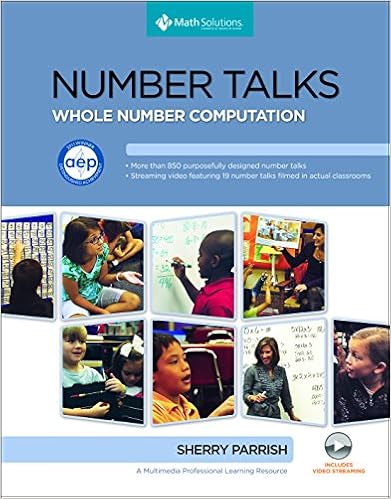
While I was listening to her explain Number Talks I started to think...... how could I make this work in writing? I quickly asked Em if I could borrow her book and read it over the summer.  I didn't need to read much for all the ideas to start storming my head. Then, I got to work.  For the past two years I have been testing Writing Talks out on my firsties.  I couldn't be more pleased with the results.

You may now be wondering... what is a Writing Talk? Well friends grab something to drink, maybe a snack or two, and get comfy. f

I had always been a big believer in the "Daily Fix-It".  I mean kids need to see mistakes and be able to fix them, right? I had kids who could find those missing capital letters and punctuation, BUT what I wasn't seeing was the transfer into their everyday writing.  Then, I read this blog post from Michelle at Big Time Literacy.  It was game changing for me and my students. Now instead of my students seeing sentences written incorrectly, they see them written correctly. You may be thinking, "Really? You saw that much transfer?" The answer is, yes.  I was told by our Title 1 team that the transfer was happening in their small groups.  I was seeing the transfer happen in my own classroom.  Now, I can't tell you that every single student was making the transfer because if I'm being real about this, I teach kiddos who are 6 and 7.  Knowing this means that sometimes firsties don't remember capital letters and punctuation but sometimes, they do! :)  My job is to give them repeated practice so that in the future, this becomes like breathing. I wrote these "talks" for first graders, but you can totally use these writing talks for kindergarten, first, or second grade.

This is what it looks like. I put up a sentence on the board. At first, they are easy and mostly include short vowels. As the year progresses, we hit long vowels, vowel teams, adjectives, verbs, etc. This gives us talking points for our Writing Talk.
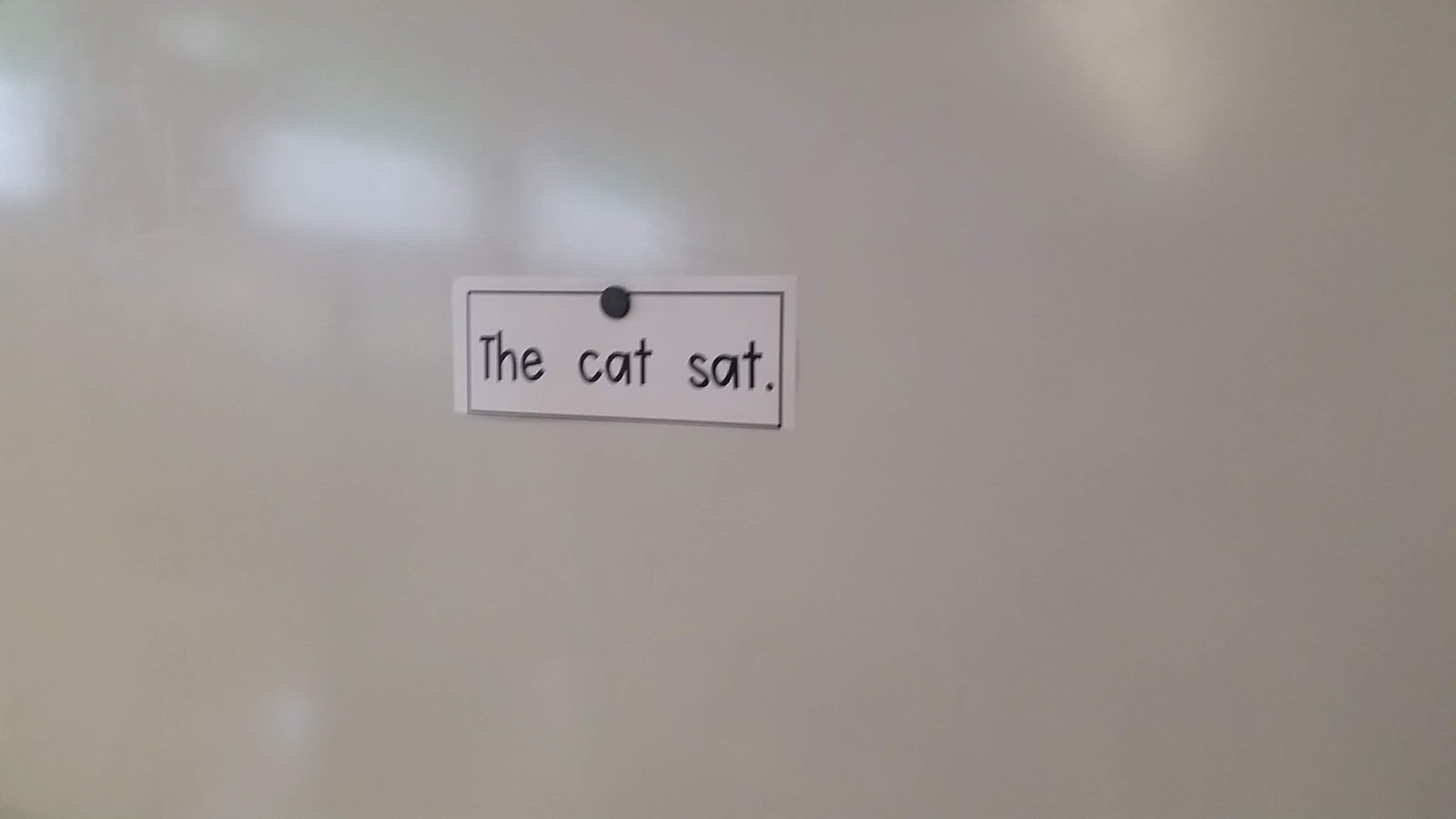
                                      (beginning of the year)


First I ask the students what they notice about the sentence that's on the board. I accept the answers students give that are relevant. Capital letters, meatball spaces between words, small, tall and fall letters, punctuation, sight words, short vowel words, etc. 

It may sound something like this:
T: What do you notice about this sentence?
St: I see a capital letter at the start of the sentence.
T: Yes, that's right. All sentences start with a capital letter. Mirror (or whatever you do for repeating)
Sts.: Mirror
T: All sentences start with a capital letter (I motion both my arms up).
Sts: All sentences start with a capital letter (doing the motion as well).

We do this for each thing that is noticed. Then, I have the students write the sentence correctly after I model how to write it. When I'm writing I would say, "We will start with the word "the" the 't' is a capital letter because all sentences start with a capital letter. Then I have a tall 'h' and a small 'e'.  After that we need a "meatball space". Then I write the word ball.  It's a tall, small, tall, and tall. We need a meatball space. "  
I go through this for each word in the sentence. 


When we're finished I remind the students to check each word to be sure it looks like my sentence. Then, I go around to each student once they are finished and check their work.  If a letter isn't formed correctly or something is missing, I write it in highlighter and the students have to trace over it.  Below you'll see a picture of the paper the students would get.


 If you're interested in this product, I will give it away to the first 6 friends to leave a comment.   If you'd like to take a peek at it, click the picture above!  OR right here. :) 


Using Dialogue to Inspire Writers

Feb 28, 2019


Our young readers and writers in first grade have many "tools" in their toolbox by this time of year.  It can rewarding to the student (and teacher) to see them trying out some of their new skills through writing.  Just last month, one of my striving readers started to really notice quotation marks in the books from her intervention group and tried to utilize this observation in her writing.


Now...by observing her writing, there is a lot we can work on here.  But the excitement to add this new learning into writing is there.  And we will run with that!  Let's look at where to begin.


First up...introducing dialogue with a mentor text.  The possibilities of books with dialogue are endless.  Truly.  But one that I wanted to introduce to you (or remind you of) is Iris and Walter.  If you are a fan of Henry and Mudge, Annie and Snowball, Mr. Putter, or Frog and Toad, then this is another series to add to your library.

Iris and Walter are new friends.  Each book features a moment in the life of a kid: field trips, friendship, substitute teachers, and new babies.  The dialogue between them is very true to how you would imagine two friends talking.  This is why I like to use it when taking a closer look at dialogue in writing.  Here is an example of when Iris and Walter first meet each other.


After reading the mentor text and pointing out the dialogue, it is time for students to create some dialogue of their own.   I constructed a Powerpoint that provides the opportunity for you to scaffold your instruction into an "I do, we do, you do" model.

Striving to Thriving Writers... GIVEAWAY!

Nov 25, 2018

Do you have writers?  Do you have writers who are thriving?  Do you have writers who are striving?  Do you have writers everywhere in between?  We do.

Our writers have come to us in all different shapes, sizes, and most importantly abilities.  In a dreamy world, all our writers would come in confident and writing pages upon pages, BUT.... writing is H.A.R.D.!!!  Our firstie writers have to do a LOT of work to get their words down on the page.  We need them to become authors. We strive for them to become authors. The odds for them to become a professional author is .04%.  Not good. But we're not looking for them to do this as a profession, we're looking for them to view themselves as authors for their lives.


In our never ending crusade to get better at our craft, we were asked to read and blog about From Striving to Thriving Writers by Sara Holbrook and Michael Salinger.

We dug right in.  The authors begin with a quick introduction that dives into the importance of writing purpose, audience, and interest, which can be achieved many times through content area writing.  They go on to explain what their writing frameworks are and the process to implement them.

There are 27 different writing frameworks that are ready to be implemented. These frameworks help every writer in your classroom.  Each framework includes the time, materials (can be found online), focus skills, the grade band (this is an important feature, to us), and the lesson to be used in the classroom.  Even the mentor texts are included and ready for use.  Samples of student writing are also found throughout the frameworks, which really helped us to visualize the student expectations.


As we read through the frameworks, it became clear that we could not just write about this teaching resource, we had to put it into action.  So that is just what we did.
___________________________________________________________________________

November means change.  Summer has turned to fall and fall is slowly (or quickly) turning into winter.  We use this time to examine the changes that have taken place between our lives now and the lives of people long ago.  Framework 12 is titled "Then and Now: Charting Change" and it seemed like a perfect fit for us.

Starting with the mentor text from Holbrook and Salinger, the students examine the back and forth nature of then and now.


Then we took a look at how people lived long ago: how they looked, what they ate, where they lived, and how they moved.

Sara Holbrook and Michael Salinger include (what they call) GO sheets to help the students organize their thinking.  Since we were marrying this framework with our current work, we added to the GO sheet.  This helped our firsties look at the specific parts of the informative piece they were writing.  We even differentiated it for some of our writers that needed to focus on fewer facts about long ago.


From Striving to Thriving Writers helped us to have some good, hard conversations about what we are currently doing, what we could be doing, and how to integrate those.  We will share with you the frameworks that we continue to try out and implement.

This book is a great resource to help you take a closer look at your writing instruction.  Grab your own FREE copy of this book by entering in the giveaway below (U.S. residents only, please).


a Rafflecopter giveaway


Opinion Writing with Miss Turie's Magic Creatures

Sep 30, 2018

I have seem many lessons out there on opinion writing about pets.  There are some great mentor texts to use that support students in this writing process
  •  The Perfect Pet by Margie Palatini
  • Cats Vs. Dogs by Elizabeth Carney
  • One Word for Sophia by Jim Averbeck
  • Can I Have A Stegosaurus, Mom? Can I Please? 
  • I Wanna Iguana by Karen Orloff
 But I recently had one sent to me from Innovation Press.

https://www.amazon.com/Miss-Turies-Magic-Creatures-Keller/dp/1943147418

Miss Turie owns a pet shop and she has one guarantee: to find the right pet for you!  A young boy comes in to find his perfect pet and Miss Turie shows him around.  Each creature is mythical and magical, but not right for him.
This book is colorful and fun.  It is full of speech bubbles and curious magic.  One of my favorite parts about this book are the last four pages.  One these pages, the author shares a little history about each of the mythical creatures within the story.  This lends itself really well to opinion writing :)

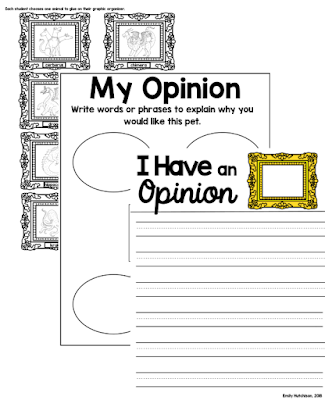
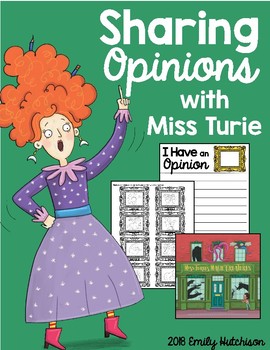
This freebie includes images of each "pet" within this book.  Students pick the pet that would be best for them.  Then they explain why.  There are differentiated versions of the webs and paper choices.

https://www.teacherspayteachers.com/Product/Miss-Turies-Magic-Creatures-Opinion-Writing-4082174


If you would like to check out this book, just click on the image above.  And grab this companion product (FREEBIE) by clicking on the image below!  Hope you enjoy the books!

https://www.teacherspayteachers.com/Product/Miss-Turies-Magic-Creatures-Opinion-Writing-4082174

Working on Positive Actions

Oct 15, 2017

We all like to hear positive things.  And children are no different.

After reading and having discussions about working towards a more trauma-sensitive classroom, I continued to think about what I can do in my small groups to highlight the positive actions that occur.


After a running record, I have always talked to my students about what they are doing really well and what they can work on.  Always emphasizing that they are not alone and I tell them what I am going to do to help them with that skill.

But I wanted to do a bit more.

I am still having this conversation with them.  But I am also writing down one positive thing they are doing in a card to their families.  I write it quickly as I am taking notes on their reading. The note may say..."Ruby was looking at beginning sounds when reading today!" So this is not taking a lot of time.  But my students are really excited to have a little note to take home!


We use LLI as an intervention in our school.  Every other day, students write about the text during our small group lesson.  It is so easy to point out everything they are doing incorrectly when writing.  But, of course, this would be so deflating and pointless.  So this year I started pointing out some of their positive actions with little stickers in their books.


It is really simple.  And probably a bit silly.  But I want them to feel good about what they ARE doing so that hopefully they will keep paying attention to those details.

I also want to share something I observed in Maria's room.


These are golden frames that hang on one of her bulletin boards.  She hangs up work and writes down what the student did well.  I love how specific it is and it models the behavior for other students.  It is a simple, quick, and easy way to point out the positive for a student.

I completely recognize that none of these ideas are ground breaking.  But I know I needed a little push to add more of these actions into my daily routine.

Now I just need to just keep it up!

Em

Writer's Workshop: Conferencing

Jul 6, 2017

I know it's summer, but my gears never shut off.  They may slow down a little but, but there is not a shut down mode on my teacher brain.  I partially think this is because I'm doing what I love and I LOVE what I do.  Teaching only writing to our firsties has opened up an amazing world for me.  Throughout the summer I'm just reading and researching to better my craft and I find so much joy in learning.  Towards the end of my school year I had noticed that taking notes during my conferences had really gone by the wayside.  We were still having great conversations, but I just wasn't writing things down for me or my students.  This was not good.  Especially when we came to the next conference and I thought we had talked about things to try but neither of us could remember.  It was ok, but I knew I had to get better so I jumped online.  I came across Julie Shope's Writing Workshop Checklist. You can check it out here.  She did a fantastic job, but it just didn't fit what I needed to help my littlest authors.  That's when I decided to make my own.  They are common core aligned and really just hone in on what I need my firsties to do.


Here's how I intend to use these guys.  When conferencing with my firsties I will highlight what he/she can do and focus on one thing they can try.  Both will be highlighted.  At the bottom, I will write a little note that will include encouragement as well as a suggestion.  Then, the firstie will put this notes page back in his/her folder and off they will merrily go to try out what we discussed. (I do snicker a little at this comment because I know we will probably have the same conversation the next time we talk. hahaha) I do love how each firstie will keep this notes page in their writing folder for safe storage. I love how we will be able to take it out over the course of a unit and see our conferences together, what we've talked about, and the growth that has been made as an author.  I also think I'll send these little babies home at the end of each unit or save them for parent teacher conferences. That's yet to be decided.  Click the above images or HERE to get this packet for yourself!

I hope you'll be able to use these in your classroom and I'd LOVE, LOVE, LOVE any feedback you have. :)

Happy writing!!!

A Mentor Text to Warm Up Your Winter

Jan 1, 2017


Happy New Year!  2017 is here and what better way to kick it off then to try out some new mentor texts in your classroom!  Today you can click through and find some lessons to help you "warm up" those long winter days.  I am excited to share a new favorite book, Bunny Slopes, by Claudia Rudea.

 This text is perfect for the PreK-1st grade age range (although, my second grade daughter really enjoyed reading it, as well).  The main character is a bunny and he is eager to go skiing; however, in order to do so, he asks the reader for some help.  In order for the bunny to go skiing, the reader must shake, tilt, and turn the book.  In the end, the reader is going on an adventure right along with the bunny!  It is simple, sweet, and (the best part) interactive.

Students make an interactive verb book

For this text to work, students must actually interact with the book and the characters.  What better way to introduce verbs!  A verb is an action and to make this type of book work, students must preform an action.  The lesson outlined below will work for a variety of classrooms, depending on their level of need.  Some students may be ready to discuss the different shades of meaning with verbs, while other classrooms may just be learning what a verb is.

Honestly, I would jump right into this book without an introduction.  It is such a fun book and I want the students to just enjoy it the first time that it is read without looking for verbs or predicting what is going to happen.  Just let them enjoy it the first time around.  But after that initial read, then the teaching can begin with one question, "What did the bunny ask us to do?"  By asking this one question, we can begin to help the students define the what a verb is.  It may be helpful to write the definition and the words "shake, tilt, and turn" on chart paper.

Then it is time for the next read.  But this time students need to listen for verbs, or action words.  When the verbs are found during the second or third read, they can be added to the chart paper.  But the students can also continue to interact with the book.  This brings the verbs to life and helps them to understand that they are action words.

Only a few verbs are used within Bunny Slopes; however, after reading the book the students can be invited to come up with some of their own action words to add to the list.  Students can even act out these words.  I always like to provide some non-examples, as well, to help them really distinguish between what is and is not a verb.

To help students have a better understanding of how to use verbs, they can create their own book.  And the best part...the readers will interact with the book using the verbs that your students choose!  This book can be used in several different ways (depending on student need): shared writing, class book, or individual books.  Here's how it works as an individual book...
Each students receives a four page book, a title page, and a bunny.  They must complete each page by writing the word "bunny" and one verb to explain what the bunny is doing.

a mentor text lesson

Then the character must be cut out and the title page constructed.  To make the title page, students need to cut out the image, fold, and glue the sides down.  This creates a "pocket" for the bunny to fit into.

a mentor text lesson

Once the book is complete, the reader can use the bunny to "act out" the verbs in the text.  It becomes an interact book!

A mentor text lesson

When choosing the scenes for this book, I had "shades of meaning" in mind.  Students are going to come with varying vocabularies and this lends itself really well to creating lists of verbs that could be used on each page.  Take the image above.  The bunny ______ in the snow.  The student above decided on sniffed.  But there are so many verbs that would work: romped, stomped, played, hopped, hid, etc.  Each student book could turn out very different, which allows for more vocabulary development to occur, especially since the books must be "acted" out with the bunny.

If you would like to use this lesson in your classroom, please click on the image below!  Or you can pin for later!   Thanks for reading today! -Em

https://drive.google.com/open?id=0B3eyEJCd5J5kdmQzaFpRRGp0TjAInteractive verb book included

Don't forget to hop through and read about all the great mentor text lessons that can warm up your winter!  You can also enter the Rafflecopter and win ALL (yes...ALL)  of the mentor texts in this hop! My mystery word is SLOPES!

a Rafflecopter giveaway

Making Interactivie Writing More Interactive

Dec 13, 2016

Many, many years ago, I attended a session that discussed the components of interactive writing.  At the time, writing was not even close to a strength of mine and I had a lot to learn.  I did learn that interactive writing is the act of composing text with your students; however, you "share" the pen with them.  One big take away from the session was to have ALL students writing during an interactive writing lesson with white boards, rather than one student at a time writing on the shared paper.

Looking at how to keep all students engaged during interactive writing
I loved this idea and (of course) played around with it as soon as I was back in the classroom.  But as my job has changed throughout the years, I have had less opportunity for interactive writing...until...now.

This year my school adopted LLI (Leveled Literacy Intervention).  Every other day, the students write about their reading and interactive writing is a part of this.  It has been a lot of fun for me to utilize this teaching technique in my routine.  The students and I decide on the sentence(s) that we would like to write.  Then we begin.  I share the marker with the students and it turns into a product like this:


As one student is writing on the shared board or paper, the other students are writing on their own white board.  If it is a sight word that I want them to recognize quickly, I will typically ask them to erase their boards and write it again.

What I have found: 
  • The student that I choose to "share" the pen typically needs some support on the skill that I am asking them to write.  I pick this child on purpose because it allows me to have a quick teaching moment with them.  For example: the work may be "take" and I pick a student that has not been consistently reading and writing words with the "vce" pattern.
  • Students that are not "sharing" the pen at that exact moment are still engaged in the writing because they are writing the word on their own boards.
  • I am still able to monitor students that are writing on their own personal white boards.  This allows for some quick teaching moments when they are struggling with a particular skill.
The struggle:

 For me, one of the struggles I had with adding personal white boards into the mix was wasted time that could occur.  What I mean by this....constant erasing of letters or writing excessively large.  Not that this is a huge issue or could not be remedied by some good behavior management.  But it was something that would annoy me.

But this year, I found a solution.  In the past I have used some of the smaller dry erase boards from the Target Dollar Spot.  These worked fine.  I also had some of the dry erase stickers on my table last year.  This did not work out well.  Lots of picking at it by students, left them looking very disgusting.
This year I found the dry erase tape. 

Looking at ways to engage All students during interactive writing

What I like about this tape is that I can cut it into smaller strips.  Then I can leave the back on (so it does not stick) and tada! I have small white boards that are big enough for students to write one word at a time on them.  They are also small enough for me to keep in a pocket right next to me.  So I can grab them quickly and we can get started.

Looking at ways to engage All students during interactive writing

Does this sound like anything that you already do or something that you could see yourself adding?

Em

Personal Narrative Anyone?

Mar 28, 2016

Prior to spring break, our little firsties were writing personal narratives.  I'm not going to lie to you..... they are NOT my favorite writing piece to teach.  I'd much rather teach something like nonfiction, how-to, opinion, something that has more structure. A writing piece that is more straightforward.

After a one year hiatus from personal narratives, I decided to add them back in.  This time was different though.  They were moved to a different time of year AND we only used Knuffle Bunny by Mo Willems (all three of them).  This year was also different because we used the nesting dolls to talk about how we have our big events, BUT..... those big events are full of smaller ones.


I tried and tried to get this across.  I'm not going to lie, I still have kiddos who can't get down to that one little event.  They are stuck in the big.  No matter what I say, no matter how we whittle it down, their little brains can't handle only talking about the small event.  This year, this time around.... I'm ok with it.


We worked on adding details to our sentences.  Again, I had a few risk takers, some just aren't there yet, again... it's ok.


Then, we talked about catchy leads and interesting closures. I had a few takers on each of these.  This little firsties had a terribly boring lead, but this is what she wrote after we had conferences.

Our personal narratives are finished, except we're publishing them.  I wanted to be finished before we left, but things happen, so we will finish that part up during writers workshop when we return.  I have the task of grading these precious little stories over spring break.  I have to laugh because near the beginning of our blogging career, I pinned a "Small Moments" rubric.  Each time I see it repinned, I just crack up because it is HORRIBLE!  I mean at the time I was like... "I'm awesome", but right now am so embarrassed by it I just want email the person who pins it to let them know I'm much better now!  And so you don't have to pin that horrible rubric, you can pin this one!  :)  It's MUCH better.  It's totally aligned with the common core standards and I love it!  It makes my grading life so.much.easier! And it's yours, just click on the rubric below!!!!


Happy Spring Break Friends!!!!