Showing posts with label math. Show all posts
Pigeon Math Story Problems-FREEBIE
Jan 4, 2020
I am all about themed story problem units! They engage students and keep them invested in the story being told. So when I read Pigeon Math by Asia Citro, I knew that it was a great springboard for a new themed unit.
The book introduces story problems by adding and subtracting pigeons in and out of the story. The characters have silly faces and funny situations, so it will get students invested and interested. Once this is read, I would dive right into students solving problems with birds on and off a telephone wire.
Starting With the Why
Sep 9, 2018
Did I tell you? I have a new math teammate this year. It has been a lot of fun to share ideas, listen to ideas, and learn about new resources. I can be awfully opinionated when it comes to math because for so long I had no knowledge, no deep understanding, and no confidence. Because it took me until my adulthood to have a foundational understanding in basic math, I now have opinions. Our students deserve the best math instruction.
And when there is a new teammate on board, I have to be sure to listen. Then share my thoughts. But listening is key because I have more to learn.
This year Ryan started off his year like we have done in first grade previously, but with some added twists!
But let's back up, just a bit.
Many times at parent teacher conferences we hear, "they don't have a math brain." Or, "I wasn't good at math, so they are not either." Basically, there are already preconceived notions about math. Very often we have found that young children do not understand why math is important in everyday life. So we have to take time at the beginning of the year to start with the why.
Ryan did just that this year. He started with a simple web. It posed the question, "Why do we need math?" There may have been some cricket noises, but a couple of reasons were given. This is to be expected and perfectly okay. Because now the brainstorming can begin!
This Powerpoint has slides within it from around my neighborhood. Phone numbers, speed limits, gas prices, and addresses are some of the images included. Once you display a slide, just ask the students to talk about it. Share their thoughts about how it relates to math and why it is so important to us. Just click on the image to grab it for free.
Ryan also used a video this year.
As the powerpoint focuses on signs and symbols around the community, this video focuses on professions and actions you take to utilize math skills. Sports, construction, shopping, and driving are all included.
So what did the kids come up with? Remember that web that Ryan started with the students? They came back to that and added to their thinking. This picture speaks louder than my words. The blue is before the Powerpoint and video. The purple is after.
Conversation in the classroom is so powerful. Just look at what it did!
Math Practice...What Should It Look Like?
May 7, 2018
Raise your hand if you have been traumatized by math in your life? Do you have math anxiety? I'm going to say that is a strong YES for me. It was not until my adult life that I realized I was not taught math in a way that made sense to me; therefore, I just thought I was not good at it. This is certainly not true. But it took me way too long to figure that out.
Currently, I am reading Mathematical Mindsets.
I highly recommend this book. It is helping me to confirm many things that I have been reading over the past few years about math and the way that it is taught. This book has also helped me to realize that I was never given time to fully understand math. Instead, procedures and rules were fed to me, which led me down a path of not having foundational number sense needed to play with numbers.
Boaler says...
So I need to continue to chew on this thought over the summer. How can I continue to work with students on their number sense and application of understanding across a variety of problems? As I read more of this book, I hope to gather some more ideas on this subject.
Em
Currently, I am reading Mathematical Mindsets.
I highly recommend this book. It is helping me to confirm many things that I have been reading over the past few years about math and the way that it is taught. This book has also helped me to realize that I was never given time to fully understand math. Instead, procedures and rules were fed to me, which led me down a path of not having foundational number sense needed to play with numbers.
Boaler says...
Notable, the brain can only compress concepts; it cannot compress rules and methods. Therefore students who do not engage in conceptual thinking and instead approach mathematics as a list of rules to remember are not engaging in the critical process of compression, so their brain is unable to organize and file away ideas; instead, it struggles to hold onto long lists of methods and rules. This is why it is so important to help students approach mathematics conceptually at all times.What does this mean to me? My students need to be playing with numbers. Talking about problems. And seeing a variety of problems and solutions. Boaler goes on to explain that practicing a method over and over and over again is not helpful. Students must see math concepts in a variety of different situations. Isolating a method does not help students to apply those methods to actual problems.
So I need to continue to chew on this thought over the summer. How can I continue to work with students on their number sense and application of understanding across a variety of problems? As I read more of this book, I hope to gather some more ideas on this subject.
Em
Make Math Real!
Aug 13, 2016
![]() |
| graphics: red pepper and madscrapper teaches |
I know that I did.
I always felt like I was not "good" at math. It did not make sense to me. I have heard this same statement year after year at conferences with parents. Because math did not make sense to me, I did not place as much importance and value on it during the first few years of my teaching life. And I think this can happen not only in the classrooms, but in the homes, as well. Reflecting back now, I was just not taught math in a way that made sense to me and I am sure many parents are in that same boat.
So when it comes to educating our students in math, sometimes we have to re-educate ourselves, as well.
This past week my teammate and I presented at a local conference about the importance of making math REAL to students. What I mean by this is connecting math to the everyday life around them. When Jess and I sit down to plan we always start a lesson that will connect them to the Now and make it relevant to them.
When we presented, we decided to take each Common Core domain and share ways that we try to make it "Real." Then we had the audience share out ways that they do this in their own classrooms. We listed them on big sheets of paper.
Our hope is that everyone would come away with ideas to make math meaningful to our young students. So much about our math instruction can easily sway towards abstract. But if we can make it as concrete as possible, our students will have a better understanding, appreciation, and attitude in the end.
One thing we offered our audience was a graphic organizer with PreK-2 standards listed by domain. Then there was a section to write down ideas to make each standard concrete and "real." One more column was added for notes. This may be where you write down what bombed, went well, or ideas you have for the next year.
It is a simple tool, but an important one, that can help us to think about our little learners and their need to make connections to the world around them. If you can use this, please just click on the image above and it is yours :)
Family Involvment: Game Nights
Aug 5, 2016
How does family involvement work at your school? Every school is so different. It has been interesting to watch the evolution of events since I moved to the Title I position at my school. Reaching out to families is a component to Title I funding. My first year as a Title I teacher, my team hosted a family night. We had 1 attendant.
Flash forward to my 6th year in this position (is that right?)...
It was not the fault of the families that no one came to my first family event. It was my fault for not being engaging. I want families in our schools. I want them to participate, talk, see what we are doing, and help me to be the best educator I can be for their kids.
So this past school year, we did things a bit differently. First of all, we had the Readbox. I know I have talked about it a million times. But it was a great way to be outside every day, talk to families, and get books into the hands of their kids.
But...We also added a Monthly Game Night.
Honestly, we were not sure how this was going to work out. But we knew that we wanted our students to have more opportunities to problem solve, be critical thinkers, and play. We thought a Game Night would be a good idea because with the influx of video games, iPhones, etc. Board games just aren't pulled out as often.
But where to start? What did we want it to look like each month? How would we get the families to come?
The Games
We started with a schedule. All the dates were picked and we decided to have a monthly theme. One month was all about checkers...another month was centered around Pictionary...while another was classic board games. Here is what our months look like:
September--Puzzles October--Pictionary December--Checkers January--Board Games March --Math games April --Create a Game
May --All games
The Food
But games were not the only thing we added to these nights. We also included food. Because food always makes things better. :) Since we are a primary building, we added some alliteration to the food that we served. Some months it was a full meal and other months it was just a snack. A few examples: puzzles and pizza; hot chocolate and checkers; pictionary and popcorn; spaghetti and subitizing!
The Decor
Typically when we have big school events, I love to dress the part and decorate the school. But our game nights were happening every month. I could not possibly keep up with all that decorating and planning. So we didn't. The game nights were simple, to the point. We had the games and the food. And you know what...that was just enough!
The Logistics
Invitations were sent home a few times before the night of the event. For every family that RSVP'd, we put a bracelet reminder on the child the day of the event. Once the families arrived, they signed in and grabbed the game, and started playing. 15 minutes into the event, my teammate and I would make a quick announcement about what we do as Title I teachers, why we picked the game of the night (strategic thinking, problem solving, etc), and how it connected to classroom learning. Food would be served, once the games were well underway or winding down. Each game night lasted for one hour and we asked them to fill out a quick evaluation on their way out. And many time we had something for them to take home with them: pad of paper to play pictionary at home, copy of a checker board, or subitizing card game.
The Impact
What we found is that families came! Families had fun! We had fun! It was a great way to get to know families, interact with our students in a fun way, and share our learning standards in a creative, engaging way. It did take me away one night a month from my family. So they came to me and played along.
The Cost
Honestly, the cost was not bad at all. For the games, we asked for donations from staff. Old puzzles, board games, or large pads of paper for Pictionary were all donated. We also found some at garage sales. The checkers boards were just printed off on cardstock with two colored counters. And the math games were just the games we were already using in the classrooms.
Most of our cost came from the food. So we got very creative. I watched for sales on pasta, macaroni and cheese, or bags of pretzels. We picked foods that would serve many. Because of this, we were able to feed a lot of people for a very small price.
Game Nights are going to occur again this year. My teammate and I loved them! We looked forward to them every month because they were just a lot of fun. I have created a small pack for you, in case you would like to host one game night or many! It includes the invitation, bracelets, and raffle tickets.
Are there any ways that you engage families that you really enjoy? I would love to add them to my toolbox!
Building Off Measurement Misconceptions
May 29, 2016
Last school year, I had a few favorite lessons. One that really sticks out for me in math class was this one:
You can click on the image for the original post. I could.NOT.wait to do this lesson again this year! But as we all know....no two lessons are ever the same!
This year Jess and I decided to start our measurement unit out a bit differently. We started with measurement mistakes or misconceptions.
We projected these task cards from Susan Jones and had a whole group discussion about what they thought went wrong with the measuring. WOW!! We were not sure how this was going to go because it was literally the opening lesson to measurement!! But the students came up with great thinking for each of the images that we showed. Then we tested out their new knowledge with some car (or carriage) ramps. Jess and I even tried to measure using some of the incorrect examples, but we could not fool them!
To end our study of non-standard units, I was excited to create another town (just like the lesson above) for the students to "hop" into and measure distance. Last year, we found that this lesson was a bit challenging for them. Especially when it came to applying the knowledge:
But this year proved to be a bit different. The actual measurement from one location to another was not a challenge. They were able to problem solve over rivers and around grasslands.
What turned out differently was their desire to test out theories. Jess and I asked them to find the shortest path from one location to the school (because you never want to be late to school!) After one person would make a path, the other students would want to see if there really was a shorter route. And in all cases...the first person always seemed to find the quickest route, even after lots of other attempts.
I felt like the town lesson was actually easier this year. Could this be from the increase in constructive struggle that we added to our instruction this year? Could it be from the misconception lesson that was built upon throughout the unit? Or could it just be the group of students?
It is hard to determine one factor. But I'll take it!
You can click on the image for the original post. I could.NOT.wait to do this lesson again this year! But as we all know....no two lessons are ever the same!
This year Jess and I decided to start our measurement unit out a bit differently. We started with measurement mistakes or misconceptions.
We projected these task cards from Susan Jones and had a whole group discussion about what they thought went wrong with the measuring. WOW!! We were not sure how this was going to go because it was literally the opening lesson to measurement!! But the students came up with great thinking for each of the images that we showed. Then we tested out their new knowledge with some car (or carriage) ramps. Jess and I even tried to measure using some of the incorrect examples, but we could not fool them!
To end our study of non-standard units, I was excited to create another town (just like the lesson above) for the students to "hop" into and measure distance. Last year, we found that this lesson was a bit challenging for them. Especially when it came to applying the knowledge:
But this year proved to be a bit different. The actual measurement from one location to another was not a challenge. They were able to problem solve over rivers and around grasslands.
What turned out differently was their desire to test out theories. Jess and I asked them to find the shortest path from one location to the school (because you never want to be late to school!) After one person would make a path, the other students would want to see if there really was a shorter route. And in all cases...the first person always seemed to find the quickest route, even after lots of other attempts.
I felt like the town lesson was actually easier this year. Could this be from the increase in constructive struggle that we added to our instruction this year? Could it be from the misconception lesson that was built upon throughout the unit? Or could it just be the group of students?
It is hard to determine one factor. But I'll take it!
Good Lessons Sometimes Fail
Feb 16, 2016
Today was not the smoothest day in math. Could have been worse. But Jess and I were hoping for some light bulbs to magically go off. That did not quite happen.
Some days are just like that.
We felt that our lesson plans were strong. After the "I Can Teach Math" conference last week, we knew that we wanted to discuss the "distance" between numbers. We really had not used that terminology before but it made a lot of sense when they discussed it at the conference in relation to part-part-whole. Students need to have an understanding that subtraction is the distance between numbers.
We wanted to relate this concept to missing addend, as well.
And so the lesson began.
We started with a math story using a scene from a Little Critter book. The little girl blew 12 bubbles but the dog popped many of them and now there were only 5. I wanted them to see the parts of this story that made up the whole (12 bubbles). So we used this Didax number line to fill in the part of the problem that we knew.
Then we added a different color of cubes to show the part of bubbles that we did not know (missing addend) or the part of the bubbles that were popped. I discussed that we were trying to find the distance between the part that we knew (5) and the whole number (12).
The words part, part, and whole were used repeatedly over and over again. I wanted to be sure that I was connecting this learning to what they had been studying all year long; however, Jess and I found that still were not consistently able to tell us that the 12 was the whole. (Grrrr.)
Then I took this number line representation and connected it to a dry erase number line that they could write on. We circled the part we knew and drew a line at the whole number. Once again, we discussed the distance. Some students were able to start at the 6 and count this distance and some wanted to start at the 1 (Grrr...again).
I am not really "grrr-ing" at the students. It is my teaching that is the problem. It si not helping them to connect the dots.
So what do I do? Well....we go back to the drawing board. It needs to be more concrete and visual tomorrow. So that is what we will do.
We stopped, listened, reflected, and now we are changing.
Differentiated Practice with Number Bonds
Feb 13, 2016
Part Part Whole, math facts, fluency, flexibility, application....oh man! We are working so hard on these skills in our math class. But (as we all know too well) our students are mastering these must-have skills at their own pace. And we need to be available to meet them where they are.
Jess (my teammate) and I have tweaked our classroom instruction and routines so many times in the last two years because of our strong belief to support them where they are. And fine-tuning our routines...well...let's be honest, we will probably never find the best way to do it. Because our student needs are always changing. But we will certainly keep trying :)
Recently, we changed up what we call "My Number Time." This is a 30 minute block of time that we use to differentiate our instruction by providing time for independent work, cooperative groups, and small group interventions. Some students are working specifically on "their number" that they are trying to master the number bonds for. Another set of students are playing math games to build their fluency with all number bonds, doubles, making ten, or other +/- strategy. Then a third group of students is in an intervention group. Students move between these groups throughout the week.
We just changed up our "My Number Time" with these binders. The sheets within them are laminated. The gallon sized bag is filled with all the materials they could need to "play" with their number: chips, cubes, rekenreks, number bracelets, beans, markers, etc. The binders will work for any number 1-10 that a student may be working on. They can also use their notebook to record number bonds in a variety of ways.
So far all of our math classes have really enjoyed the new binders. They are so hands on and allow them to make choices for how they want to "play" with the numbers on that day. When they feel ready, they are allowed to take an assessment on the number bonds for that number. It includes many missing addend, subtraction, and addition problems.
One piece that we continued to feel was missing from this "My Number Time" was the ability to go back and "play" with number bonds that have been previously mastered. Now...they are certainly getting that practice during their game time with all number bonds. But we wanted more.
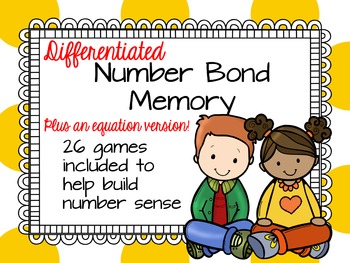
I decided to try out a number bond memory game. Again, I wanted it to be differentiated, just like this block of time is. What I came up with was this:
There are four different versions and each version is differentiated by the number bonds that the student is current working on. As soon as they were complete, my daughter and I tested them out (she needs some work in this area, too).
Version 1: Quick Image Memory
This game works on one specific number at a time. The example above is for the number 5. Students have to match quick images that have the same number bond. The two cards flipped over above are not a match because one shows 5 + 0 and the other illustrates 3 + 2. The quick images included are ten frames, dots, rekenreks, dice, dominoes, and fingers.
Version 2:Number Bond Memory
Again, this game works on only one number per game. This time the students must match the number bond to the quick image. The cards flipped over above do match because they both show 5 + 0 or 0 + 5.
Version 3: Number Bond Memory
This version is played the same way. You must match the number bond and they quick image; however, these game include multiple numbers. The game above is for the numbers 3-6. This allows my students to practice all the number bonds that they have learned for 3, 4, 5, and 6.
Version 4: Ways To Make Memory
This version is a little different than the others above. It includes equations. Students must match ways to make a particular number. For example, the cards above do not make a match because they equate to different numbers. If the cards 3 + 3 and 4 + 2 were flipped over, they would be a match!
After introducing this to my daughter, she just kept asking to play more. I found that she was really getting to know her bonds 3-6 well. That made me a happy mom.
The games are all printed, cut, and laminated for our classroom students. There ended up being 26 DIFFERENT games! Yikes! We want to use them during their group game time but we also feel that they could use the individual number games independently during their "play" with number time.
How do you differentiate for math facts and number bonds in your classroom? Do you have any tips you can pass on to us??!!
If you think you could use these games, as well, you can just click on the image below:
Labels //
differentiation,
math,
number bonds,
number sense,
part part whole,
TPT
Countdown to Leap Day...Week 1
Feb 9, 2016
I shared last week that we are counting down to Leap Day this year! What a concept for our little kiddos. 4 years!! Oh my! They have only been alive for 7 years, so to understand the concept of 4 years and the importance of adding one extra day to the calendar...that is a big idea to wrap their heads around.
As a math team, we decided to place a time object into each of the 29 bags. We would remove the item each day, turn the bag around, and make a quick announcement each morning about the time concept.
Our first three bags were all about a DAY. We wanted to reiterate that a day is composed of 24 hours and that we partake in certain activities throughout the hours of the day.
Then we moved on to week. We posted all the days of the week and a little image to show where that day is found on the calendar (I really like that visual!) We also decided to lay out one full week (at the bottom) that shows a weekend versus a school week. We are a K-2 building and we felt that was important for them to see.
This week will begin our items that are all about the months.
My favorite part about this so far...the kids "get on me" if they come into school and I have not posted the new item yet. Oops! But that tells me that they are watching, listening, and anticipating!
Let the countdown continue!
Math Teaching: Reflecting and Changing
Feb 7, 2016
Thursday and Friday were both spent at the Ohio I Can Teach Math conference alongside my teacher partner, Jess. There were four presenters that shared their knowledge on numbers sense, part-part-whole, assessments, and math in the real world. It matched up pretty well with our math philosophy and we found ourselves nodding to most of the things being said. And quite honestly, we were already implementing most of the ideas that were presented. But even with this being true, there is always room to tweak, change, and grow in areas that may already be familiar.
So, of course, I started connecting, reflecting, and making my list of changes right away. This is great place for me to share and ask for feedback on these new goals. So I am going to share what we currently do and how we are going to change/tweak it based on our new learning.
First of all, a big theme throughout the conference was that we are working towards conceptual understanding as math teacher because that is what encourages mathematical thinkers. One quote that really stuck out to me concerning this:
CURRENTLY DO:
Place value was a big topic discussed. This included place value strips, bean sticks, place value blocks, and discs. It was recommended that at the first grade level students make the bean sticks themselves so that they can see what a group of ten is composed of. Many times place value blocks can still be a bit abstract for this age.
I love this! We do make bean sticks already in our classroom for this exact reason.
CHANGES TO MAKE:
Although our students make these bean sticks and we use them for some +/- tens games, we don't use them enough. So one of our goals is to use these materials more often. Here is an example:
Our next story problem theme is "Teddy Bear Store." We are going to make crates of teddy bears to represent groups of 10. We will still do this because it is great manipulative and makes it more real life-ish; however, Jess and I have decided to transition over to the bean sticks so that students can make the connection and see a group of ten is a couple of different ways.
CURRENTLY DO:
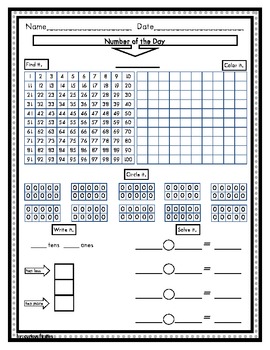
Another topic that was discussed is the importance of students representing a number in multiple ways. Yes, yes...we do this. Our "number of the day" sheet covers this pretty well. They represent a number with a hundreds chart, ten frames, equations, etc.
CHANGES TO MAKE:
But I quickly learned that representing a number in multiple ways means so much more. It means to have a deep understanding of how a number can be composed of different parts (part part whole). For example: a student should understand that 35 is the same as 20 and 15.
Okay...I discuss this with them all the time when we break a number into parts. But I really believe that I could phrase it differently to support their understanding even more. In turn, this is going to help them when they begin regrouping when subtracting.
So instead of saying "3 and 5 make 8," I want to add in questions like: Is 3 and 5 the same as 8? or "Are 12 tens the same as 1 hundred and 2 tens?" Being more purposeful and intentional with my questioning could make a world of difference when it comes to decomposing numbers.
CURRENTLY DO:
Math Talks were discussed in quite a few sessions that I attended. The book Math Talk by Char Forsten and Torri Richards was displayed and demonstrated. By displaying the pictures from the book, students are asked to tell what they see. Through these conversations, different math concepts can be taught, part part whole thinking can be encouraged, and math language can be developed.
We have been using Number Talks to support this language, modeling, and mental math development and we will continue to do so.
CHANGES TO MAKE:
We do not want to replace our Number Talk routines with Math Talk images; however, we think that using more real world images could be a great tool to support some our guided math routines.
One example that was shown was the use of a family picture. Students could discuss the members of their family through number bond expressions. YES! I love this idea for the beginning of first grade (I want to add this). Here is my example:
Three people in my family are girls and one is a boy (3 + 1 = 4). Two people in my family are adults and two are children (2 + 2 = 4). Four people in my family have blue eyes (4 + 0 = 4).
Another example given was to use pictures of things from our house, places you go, or illustrations from books/magazines. This got us thinking...we are about to start a unit on missing addend. Jess and I decided to use this new idea to support missing addend.
Using this picture above of my girls collecting buckeyes from our tree, I can say: "Gertie is holding 4 buckeyes but she found 11. How many buckeyes was she not able to fit into her hand?"
It pulls in the real world application of missing addend.
CURRENTLY DO:
Number bracelets. Love them to support part part whole thinking. We use them each day as students continue to work on learning their number bonds.
CHANGES TO MAKE:
But...I made all of our number bracelets and I used whatever colors I had. The suggestion was made that students in kindergarten make number bracelets 0-10 and first graders make 11-20. These bracelets stay with them through second grade. Then they can be taken apart and reused in kindergarten.
When making the bracelets certain colors should be used for each number. This allows the teacher to look out and know immediately that students are using the correct number bracelet. Brilliant!! Why didn't I think of this organizational tool?
A FEW MORE CHANGES:
As I reflected on my learning, there are a few other minor things I want to work on as a educator.
1. Helping students understand that subtraction is the difference or distance between numbers.
2. When working on story problems (or math stories) I want to ask, "Are we looking for a part or a whole?"
3. When teaching subtraction, I want to turn away from saying "start with the bigger number" to "start with the whole number."
So what are your thoughts? Is there anything here that you would like to change? Or any suggestions that you have for me?
Subscribe to:
Posts (Atom)