Showing posts with label phonics. Show all posts

Intervention for an Intervention

Oct 18, 2019


 I previously shared that I would like to reflect each week about a failure (because we learn and grow through them).  This week is no different!

The past two years I have used Leveled Literacy Intervention (LLI) and we (me and my students) love it.  The books are so engaging and the different characters are loved.  For the most part, my teammates and I have followed the program.  And we have seen some great growth in our Tier 2 reading instruction.

 In the training, we did learn that the phonics should meet the need of the group.  It seemed that each student in each group had a different set of needs.  So for the past two years, I have followed the phonics written with the LLI lesson.  But...yep, you guessed it.  Those gaps did not seem to fill.

This was a hard failing to swallow.  Because it was on me for not tailoring my instruction to better meet the need. It led me to some great reading.


From reading and conversations with Orton-Gillingham trained co-workers, I came up with a plan.
1. Assess reading level with F&P.
2. Assess phonological awareness skills.
3. Assess phonics skills.

Word Study and Phonics: The Next Step Forward

Oct 17, 2019

A Little Opinion from Em:
Well Jan Richardson did it again (along with Michele Dufresne, this time)!  Jan's guided reading books really helped me  to tighten and strengthen my small group instruction.  And her new book "The Next Step Forward in Word Study and Phonics" is already helping me to plan for my phonics instruction this year!


One section addresses children reading at a pre-A stage.  Yes, please!!  I jumped right to this and got started.  To begin with, students need to be able to recognize their name.  This is where I started with a couple of my readers.  Two different colored sentence strips were used.  One had the child's name printed on it.  The second strip had the child's name printed on it but then I cut out each letter.  My student worked to match the letters in her name by placing the cut up letters on top of the first sentence strip.
Once this task could be completed without prompting, I provided letter tiles and asked her to build the name.  For many of the sessions, the original sentence strip  was used to help with the building process.  But after time, she could build the name independently.


A Little Opinion from Maria:
This book is jam packed with ideas and lessons for readers at all levels.  I liked how this book is set up.  It's easy to read and if I ever (hopefully never, though) had to teach reading again, this book would be right by my side, every step of the way.

Putting It All Together: A Winter Giveaway

Dec 6, 2018

Can you believe winter is almost here and 2018 is wrapping up.  It amazes me each year how quickly it goes.  I love the end of the year because it is a time to reflect and grow. 
One reflection you may make at this time of year, is the gaps that are closing or growing between some of your students. Where do you need to push forward and where do you need to back up a bit?

Currently, I have students that are well on their way to becoming more fluent readers, while others are continuing to struggle with letters and sounds.  It is time to push forward for some and pause for more explicit teaching for others.


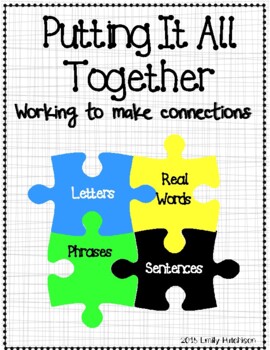
Some students do not quite know the difference between a letter, word, and sentence (this is true for many of our kindergartners).  This Powerpoint visually shows students a letter.  How the letters make up words and the words make up sentences.   I made is a short video to show you a small part of the powerpoint. Click on the slide image to purchase (Free on 12/8/18-12/9/18 only).


My first graders know the difference between letters, words, and sentences, but may still have trouble seeing how they are interconnected. I wanted needed my students to really SEE the connections.  Out of that need...this was created.  It helps students to "put it all together."

This particular version is a review sheet of short vowels.  Students have the opportunity to read words with short vowel sounds, while also engaging in a short winter story.

When looking at this sheet.  You can see that it begins with letter sounds.  Students read each letter sound. 

The second part illustrates that the letters from the first part make up words.  Blend the words with students.

These words can then be found in phrases.  (This is a great time to talk about why we read in phrases and how it can help us to sound like fluent readers).

Finally, these phrases (which include words,  that are made from sounds) form sentences, paragraphs, and stories.

Every letter, word, and phrase connects to the winter story.

There are many different ways to use this sheet.   One way to use this sheet may be to take one colored marker and highlight all the letters for one particular word (for example: "hats").  Then highlight the word "hats" in the second part.  Highlight the phrase that "hats" is found in.  Finally, find the sentence with the word "hats" and highlight it.  This illustrates to the students the connection of the letters all the way down to the story.

This particular student illustrates another way to "put it all together."  She was working on short vowel sounds in words.  She highlighted the short vowels and looked at how the short vowel phrases could be found in the story.


While each student has their own individual needs, this sheet may be used differently in your classroom; however, the ultimate goal is for them to see how sounds, words, phrases, and sentences all build off of each other.

I hope that you can use these with your students.  You can grab a free copy by clicking on the winter edition image below.  If you are looking for more "focused" sheets, you can click on the second image.  This pack has a different phonics skill per sheet.  It is a great way to explicitly teach specific skills.


FREEBIE Putting it Together: letters, words, and sentencesPutting it all together: letters, words, and sentences

Not ready to use this?  Just pin it for later!


 Thanks for checking out these products.  Although this is just a stepping stone, our ultimate goal is to always get books into the hands of our students.  I love to support any local bookstores that I can, whether it be in my hometown or a city I'm visiting.  Please enter the giveaway below for your chance to win $25 to Half Price Books (www.hpb.com).


a Rafflecopter giveaway

For a chance at more $25 giftcards and free resources, check out the sites below!


Visual Representations for Vowel Teams

Jun 29, 2015


I can't believe July is almost upon us and I am not quite sure I have done a lot of relaxing this summer.  Don't get me wrong...I have enjoyed the amusement park, pool, some hiking, and Lego building with my girls.  But there has also been reading, book studies, and research.

As I have shared this summer, the teachers in my school have been reading "Reading Reflex."


 As I finished up the last chapter, I reflected on a few descriptions that the authors made that I thought seemed helpful.  I typed them up for me to use this year.


 I like this explanation because it can be hard for some students to understand that one vowel team can represent more than one sound.  But as the authors explain, it is not hard for children to understand that the shape above could be a circle or a ball.

I really like this second visual.  Students can understand that two flowers can look different but they are still both flowers.  Two vowel patterns can look different but they can make the same sound.

This may not make sense for every student but it may help a few understand these concepts that can sometimes be a challenge.

What do you think?  Do you think this would help our young students?


Summer Stock Up: Interacting with Short Vowels

Jun 26, 2015


I love all the fresh ideas that are buzzing around during the summer months!  All the books studies, extra time to read blogs, and reflect allows me to get ready for the upcoming year.

One of my goals this summer was to prepare some interactive presentations that were engaging and powerful.  A few years ago we tried using  Powerpoints to help our students with segmenting, blending, and visually seeing how the letters come together.  Our firsties need and benefit from this type of explicit, direct lesson in phonics.


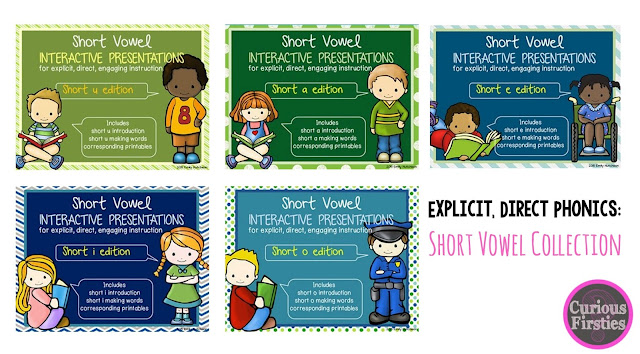
The new and improved SHORT VOWEL presentations are here and ready to use!
Each file comes with an introduction Powerpoint that works on one specific vowel sound (such as short a below), an interactive making words Powerpoint, and corresponding printable sheets for the students to use.

Since they are Powepoint presentations, I was able to make them interactive.  The letters move on some of the screens to help students see how words are formed or change.  The video below shows an example of this:


The corresponding sheets help the students to be accountable for their learning.  It provides them with Elkonin boxes to touch and segment the sounds in the words.  But then the students can write the sounds for the word inside each box.

The sentences allow the students to see the word in context.  I think making that connection from word to sentence is really important.


I look forward to creating more of these Powerpoints this summer for VCE words and vowel teams.  But if you would like to win the short vowel collection, please enter below:
https://www.teacherspayteachers.com/Product/Short-Vowel-Interactive-Presentations-for-Explicit-Instruction-short-i-edition-905568
a Rafflecopter giveaway

If you would like to try out part of the short a Interactive Introduction--plus many other freebies--please click below!


https://www.facebook.com/ThePrimaryGal/ app_208195102528120


Using a Common Vocabulary

Jun 19, 2015


A few weeks ago I shared that many teachers from my school have been doing a book study together.  It has been going well and we have one chapter left.  It has been fun to visit individual homes of the teachers I work with around the city.  Makes for a nice change of environment.
The book that we have been reading is Reading Reflex:


We have discussed Chapter 3: Teaching the Basic Code, Chapter 4: Adjacent Consonant Sounds, and Chapter 5: Teaching the Advanced Code.  Each chapter has provided us with some good conversations about how we each teach these skills in our classroom.  This led to a better understanding of how we could be more cohesive as a building.  And one way that we can do that is through the language that we use.

The book offers some interesting perspectives of the language that is used in most classrooms (this book is written for parents).  The book goes in depth explaining that letters do not "make" sounds.  They represent sounds.  They suggest the term sound picture should be used versus vowel team or other common terms.  We really liked the idea of using represent versus make.  But we also recognize that the kids we work with are very transient and need to understand that "vowel picture" and "vowel team" are terms that can be used interchangeably.

The book also points out that using the terms long and short for vowels is confusing to children because they are terms for length.  And that the term blends is confusing because we are actually blending all the sounds in a word.  I completely understand both points that they are making.  It makes complete sense to me.  But...again...our students are very transient and need to know those terms because they are used in most schools.  So we decided to stick with them.

Because the book takes a different view on vocabulary used by teachers, it has made for some great conversations.  And since we just completed our building Literacy framework, it has been a good time for us to talk about language and the instructional strategies we want to use to teach phonics.

To sum up my rambling....we have decided that we were using lots of different terms to teach the exact same things.  For example: sight words, know by heart words, popcorn words, high frequency words all meant the same thing.  We are going with sight words.  So here are some terms that we are sticking with as a building:

Do you have agreed upon terms in your school?  Do you have any suggestions for us?

Coming Soon: The book does a really great job explaining how sounds are related and not related with visuals.  This was a HUGE takeaway for me!  Be on the lookout for it :)


Guided Reading Format: A Second Look

Jan 21, 2015


 Last week I had an out of town PD and an early morning staff meeting.  One thing thing was said in both situations that struck me.  I can't put quotes around it because I never, ever remember things exactly as they are said.  But, basically, I was reminded that we are constantly in the revision process.

And we are.

Last year I posted a post about my small group routine.  Through some great PD on Jan Richardson's The Next Step in Guided Reading and observations I have made of our Orton Gillingham teacher, more revisions have been made to my routine.

 My new routine looks like this:
(based on Jan Richardson's template with my added components)

This looks like a lot and it is but I will tell you the routine is quick, efficient and when I complete the lesson by saying, "How was your effort today?" my kids reply, "What!! We are done?"
So...let's break this down.  This is a two day plan.  I fill out two of these a week and then my fifth day is for assessments.

Step One: Phonological Awareness or Familiar Reading


My first two to three minutes of group are spent on either Phonological Awareness or Familiar Reading.  It really depends on the time or year and what my group needs.  At the beginning of the year, I do a lot of phonological awareness activities.  This year I read a lot of rhyming texts and we used them to break apart sounds, count words, or change sounds.
But as the year continues, we move on to familiar reading.  Right now we are reading nursery rhymes and variations of nursery rhymes.  They are quick, simple, and fun to read.  I compiled the ones that I use here:

http://www.teacherspayteachers.com/Product/Fluency-with-Rhymes-Nursery-Rhymes-1147557

As the year progresses even further, we may use short passages or short books as our quick familiar reading at the beginning of group.

Step Two: Phonics


-Review vowels and consonants (takes less than a minute):
 I use flashcards for this.  It is very quick.  We say the sound, then the letter name. If my group does not need this review, I skip this component.

-NWF: nonsense word fluency (takes 1 minute):
 It helps me to determine if students are blending sounds accurately.  If this comes easily to my group, we look for nonsense words within larger words.  I want them to see the value in blending these sounds quickly and effortlessly.  I use these sheets for this:

http://www.teacherspayteachers.com/Product/Multi-Syllable-Words-Using-Nonsense-Words-to-Read-2-Syllable-Words-1170065

Written review of sounds (about 1 minute):
At this time I want to review vowel patterns or chunks that we have been focusing on.  To do this, I may review some flashcards, but then I ask them to write the pattern.  For instance, I will say, "Write the chunk that says /sh/."  As they write, I expect them to say the sound. I typically choose about 3 patterns.  If there is an error, I correct the individual and they write the pattern three times.
After some trial and error, I have found that it works best for me to have them write these sounds on the back of their phonics sheet (photo below).

Introduction to new sound (about 1 minute):
This is when I introduce the new phonics pattern that I would like them to focus on.  After my introduction, they write this pattern three times on their paper as they say the sounds to themselves.

Highlight Sounds or Sentences (about 5 minutes):
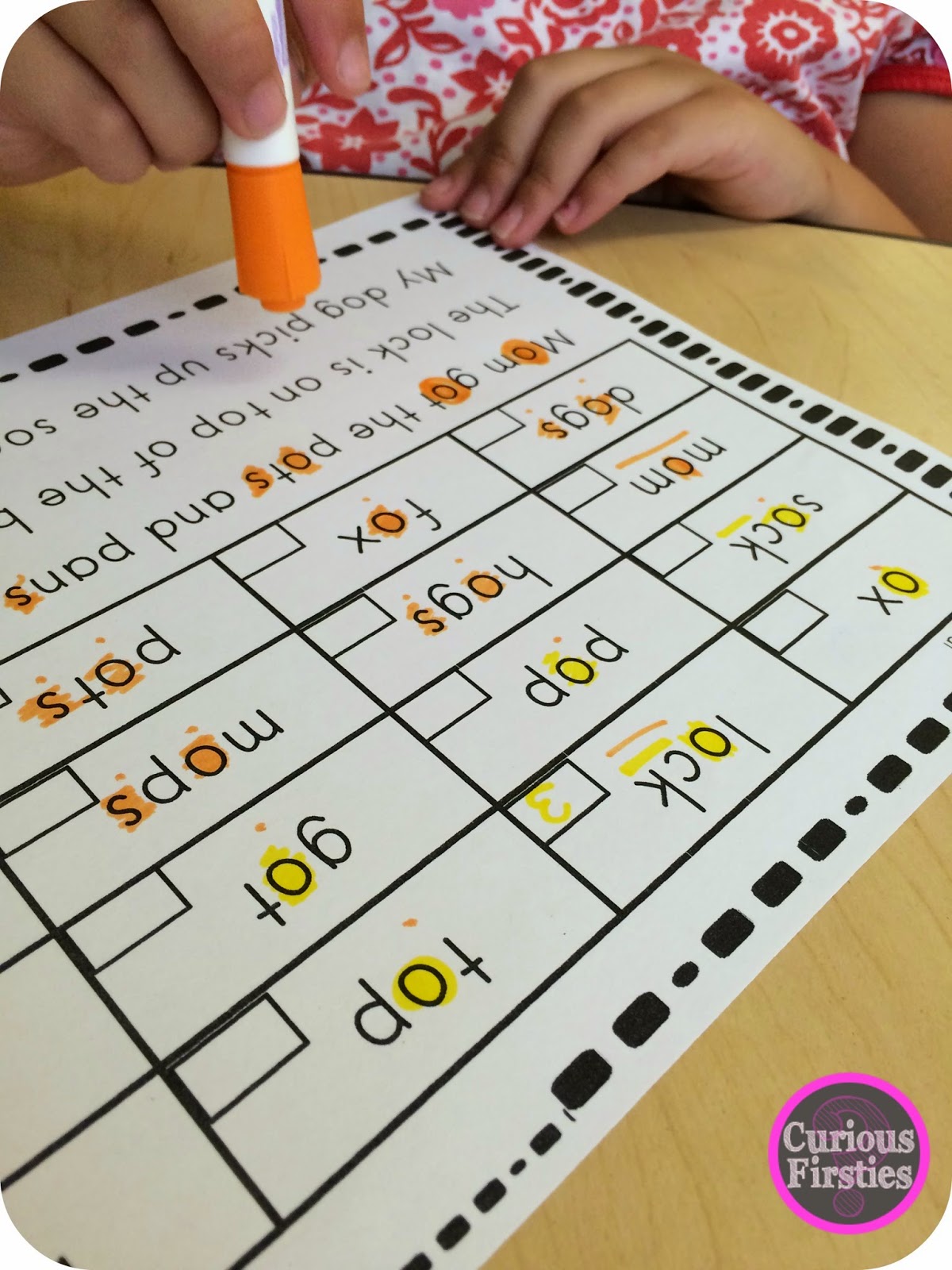
This is where we put the phonics skills together.  I use this same sheet all week.  But basically, the students are either highlighting the pattern we are focusing on or they are reading the sentences where the skill is embedded.  ( I outlined my procedures HERE.)

http://www.teacherspayteachers.com/Product/Explicit-Direct-Phonics-Decoding-Sheets-1657349

Step Three: Sight Words


Dictate Words (about 2 minutes):
I ask the students to write three of the sight words that we have been working on.  They do this on a dry erase board.  At this time, students spell the word as they write.  If there are any mistakes, I assist the child and they rewrite the word three times.


Flashcards (about 30 seconds):
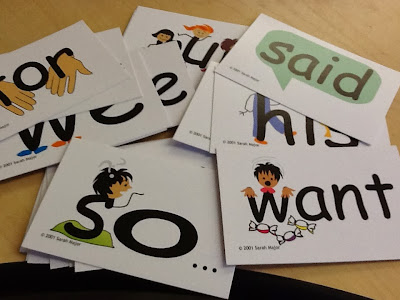
Then I use my Snapword cards to review previous or introduce new sight words.  These cards have pictures to help my visual learners but they have the plain old word on the back of them.


Phrases (about 30 seconds):
I just want to ensure that they can read these words in context.  So we read through a few short phrases together.


Step Four: Reading the Text
We read the same text for two days.  This is what the layout looks like for those days.


This is the meat of my guided reading time and it takes about 10-15 minutes (or it is my goal to spend that amount time on the book).  My introduction is quick and includes our examination of some key vocabulary words.  Then the students dig in to the text and whisper read independently. At times we chorally read together to build fluency and confidence.  The second day includes rereading but I also like to include some type of comprehension activity.

Step Five: Introduce New Sight Word

This last step is very quick.  It takes less than a minute.  I introduce one new sight word that will become part of their dictation practice that I shared with you above.  We "play" with this word by mixing up letter tiles and fixing the word or I write the word with missing letters and they correct me.

And our groups always end by discussing our effort (mine included). 
I know...it is a lot.  It is intense.  But I have really enjoyed the changes and feel like I am hitting their needs.

Plus....I am always up for more revisions :)



Explicit Phonics (with FREEBIE)

Jan 19, 2015

Planning....Does it take anyone else forever?
My guided reading plans take me quite a while to plan because I want to make sure I choose the right text and skills for the individual students I am teaching.

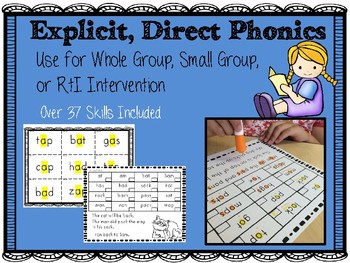
One part of my group time that was taking me a lot of preparation was the phonics portion.  I like to have the students highlight the sounds throughout the week, sort the words by sounds, and read words with the phonics skill in context.

But what I found was that I was creating new phonics sheets each week or searching through my file folders to find what I needed.  It...was...not...working for me anymore.

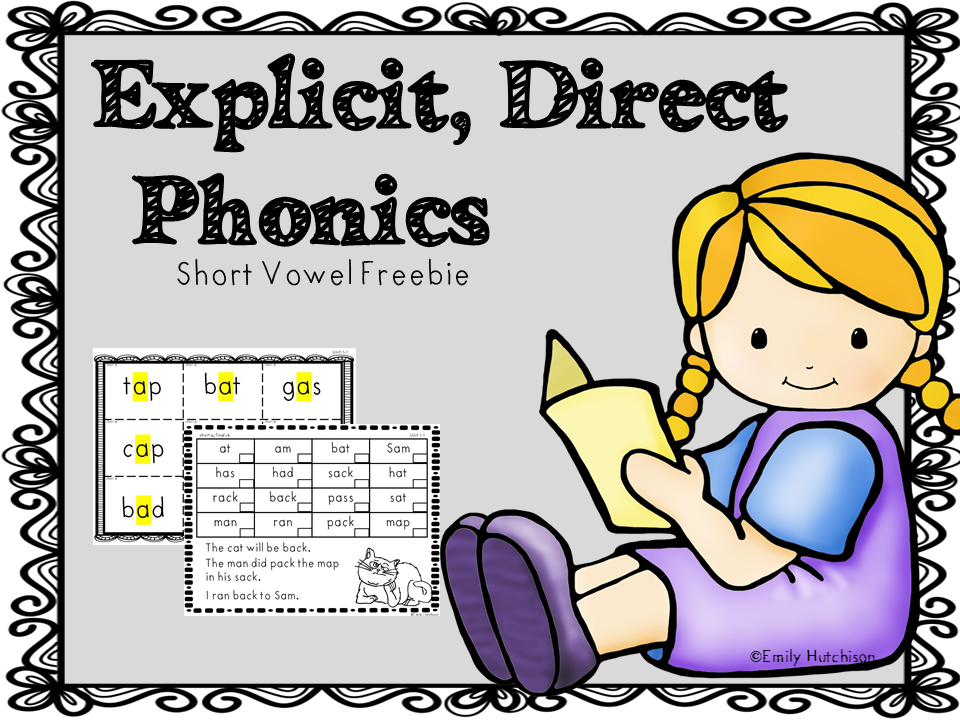
So after 6 months of slowly working on it, I finally have a completed set of sheets that I use in guided reading groups now.  YES!

http://www.teacherspayteachers.com/Product/Explicit-Direct-Phonics-Decoding-Sheets-1657349


Here is what I do:

Monday: I introduce the new skill by decoding the words together with these "flashcards."  I could cut them apart but I actually just keep the whole sheet together.

http://www.teacherspayteachers.com/Product/Explicit-Direct-Phonics-Decoding-Sheets-1657349

Tuesday: We practice this skill together by highlighting the pattern.  My time in group is short; therefore, we only highlight the first two rows.

http://www.teacherspayteachers.com/Product/Explicit-Direct-Phonics-Decoding-Sheets-1657349

Wednesday: We move on to the last two rows and complete our highlighting and decoding together.

Thursday: I want my students to use the phonics skill in context.   First, they read the sentences independently or chorally.  Then I ask them to look for the pattern within the sentences.  They get to circle the words with the focus skill.

http://www.teacherspayteachers.com/Product/Explicit-Direct-Phonics-Decoding-Sheets-1657349

 I have been using these sheets all year (as I slowly made them) and have found that the kids really enjoy them.  They love using highlighters, markers, and searching for the patterns hidden within the sentences.  Here is a list of all the skills that I hit:


https://www.teacherspayteachers.com/Product/Explicit-Direct-Phonics-Decoding-Sheets-1657349

I hope they can help your kids too!

https://www.teacherspayteachers.com/Product/Explicit-Direct-Phonics-Decoding-Sheets-1657349


If you would like to try it out first, please grab this FREEBIE below!  You can also find it on the "Teaching Blog Addict."

https://www.teacherspayteachers.com/Product/Explicit-Direct-Decoding-of-Short-Vowel-Words-1471504http://www.teachingblogaddict.com/2015/02/freebie-friday-for-lucky-friday.html