Showing posts with label subtraction. Show all posts

Good Lessons Sometimes Fail

Feb 16, 2016


Today was not the smoothest day in math.  Could have been worse.  But Jess and I were hoping for some light bulbs to magically go off.  That did not quite happen.

Some days are just like that.

We felt that our lesson plans were strong.  After the "I Can Teach Math" conference last week, we knew that we wanted to discuss the "distance" between numbers.  We really had not used that terminology before but it made a lot of sense when they discussed it at the conference in relation to part-part-whole.  Students need to have an understanding that subtraction is the distance between numbers.

We wanted to relate this concept to missing addend, as well.

And so the lesson began.

We started with a math story using a scene from a Little Critter book. The little girl blew 12 bubbles but the dog popped many of them and now there were only 5. I wanted them to see the parts of this story that made up the whole (12 bubbles).  So we used this Didax number line to fill in the part of the problem that we knew.

Then we added a different color of cubes to show the part of bubbles that we did not know (missing addend) or the part of the bubbles that were popped. I discussed that we were trying to find the distance between the part that we knew (5) and the whole number (12).

The words part, part, and whole were used repeatedly over and over again.  I wanted to be sure that I was connecting this learning to what they had been studying all year long; however, Jess and I found that still were not consistently able to tell us that the 12 was the whole. (Grrrr.)

Then I took this number line representation and connected it to a dry erase number line that they could write on.  We circled the part we knew and drew a line at the whole number.  Once again, we discussed the distance.  Some students were able to start at the 6 and count this distance and some wanted to start at the 1 (Grrr...again).

I am not really "grrr-ing" at the students.  It is my teaching that is the problem. It si not helping them to connect the dots.

So what do I do?  Well....we go back to the drawing board.  It needs to be more concrete and visual tomorrow.  So that is what we will do.

We stopped, listened, reflected, and now we are changing.

Reflection: Math Assessments

Dec 15, 2014


We have one week left of school before 2014 comes to a close and 2015 brings on new learning, new challenges, and new successes.  My mind is buzzing with holiday lists, music, and activities.  But reflection, as well.
Jess (my math teammate) and I have been working really hard to improve number sense and math fact recall this year.  And we have tried a lot of new things:
number sense activities
how I see numbers: part-part-whole 
connecting addition and subtraction 
Students have been working on math facts at their own pace and we tried assessing them through flash cards.

That didn't work.

It was a nice try but we just couldn't get to everyone in a timely manner.  We had to change it up.  And I really think it is working out well.  I hope I prove to be right when the end of the school year rolls around.

First change: "My Number Time"
We are giving the students time to "play" with manipulatives for their specific number.  They can decide what materials they would like to use.  Here are some examples:

House with beans
Plate with colored chips
Colored cubes and crayons
Rekenrek
Second change: After each "my number" time students take a quick self-assessment.  This helps them and us to determine if they are ready to take a quick assessment and move on to a new number.

http://www.teacherspayteachers.com/Product/Part-Part-Whole-Assessments-and-Intervention-Sheets-1520566

http://www.teacherspayteachers.com/Product/Part-Part-Whole-Assessments-and-Intervention-Sheets-1520566

We tell them that if the self assessment is not quick and easy, then they are not quite ready to move on.  Our firsties have really done a great job with this self assessment.  They are honest and I think it is really helping them to realize what they know and don't know (quite yet).
This sheet allows us to determine who we need to meet with the following day.

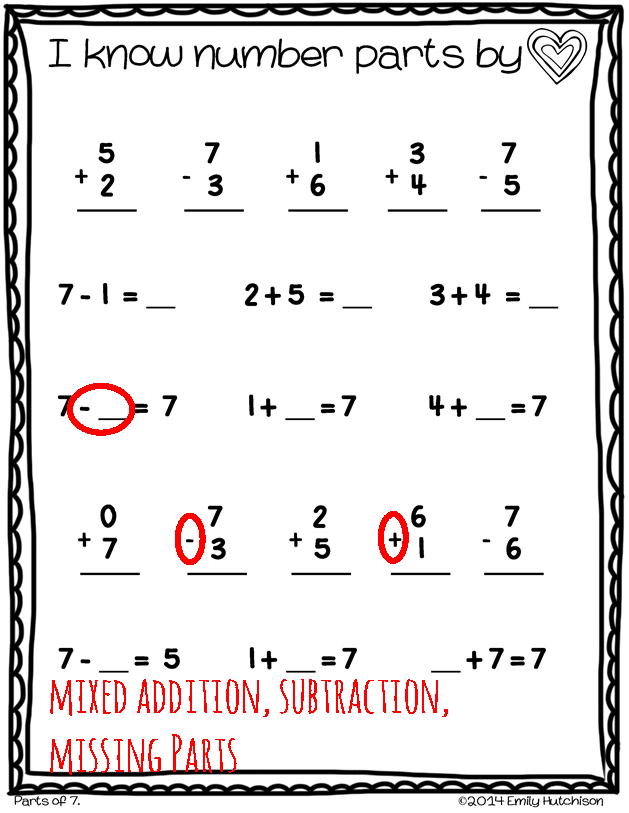
Third change: When they ARE ready to take an assessment, Jess and I pull over an individual or a small group of students to give them a fact assessment.  They look like this:

http://www.teacherspayteachers.com/Product/Part-Part-Whole-Assessments-and-Intervention-Sheets-1520566
Some are mixed sheets and some have facts for only one number.  They all include addition, subtraction, and missing number because we have been teaching all facts as part-part-whole.

http://www.teacherspayteachers.com/Product/Part-Part-Whole-Assessments-and-Intervention-Sheets-1520566

While the students take the assessment, we watch them and time them.  Jess and I decided not to set an exact time that each student needed to finish the sheet by but we really hope for it to be under 1 or 2 minutes (depending on the student).  We are trying to make sure that they don't use their fingers or another strategy. We want them to KNOW these parts.  And for some students they just need to be reminded (they need the confidence) that they do KNOW the parts.

But some students do not know the parts automatically.

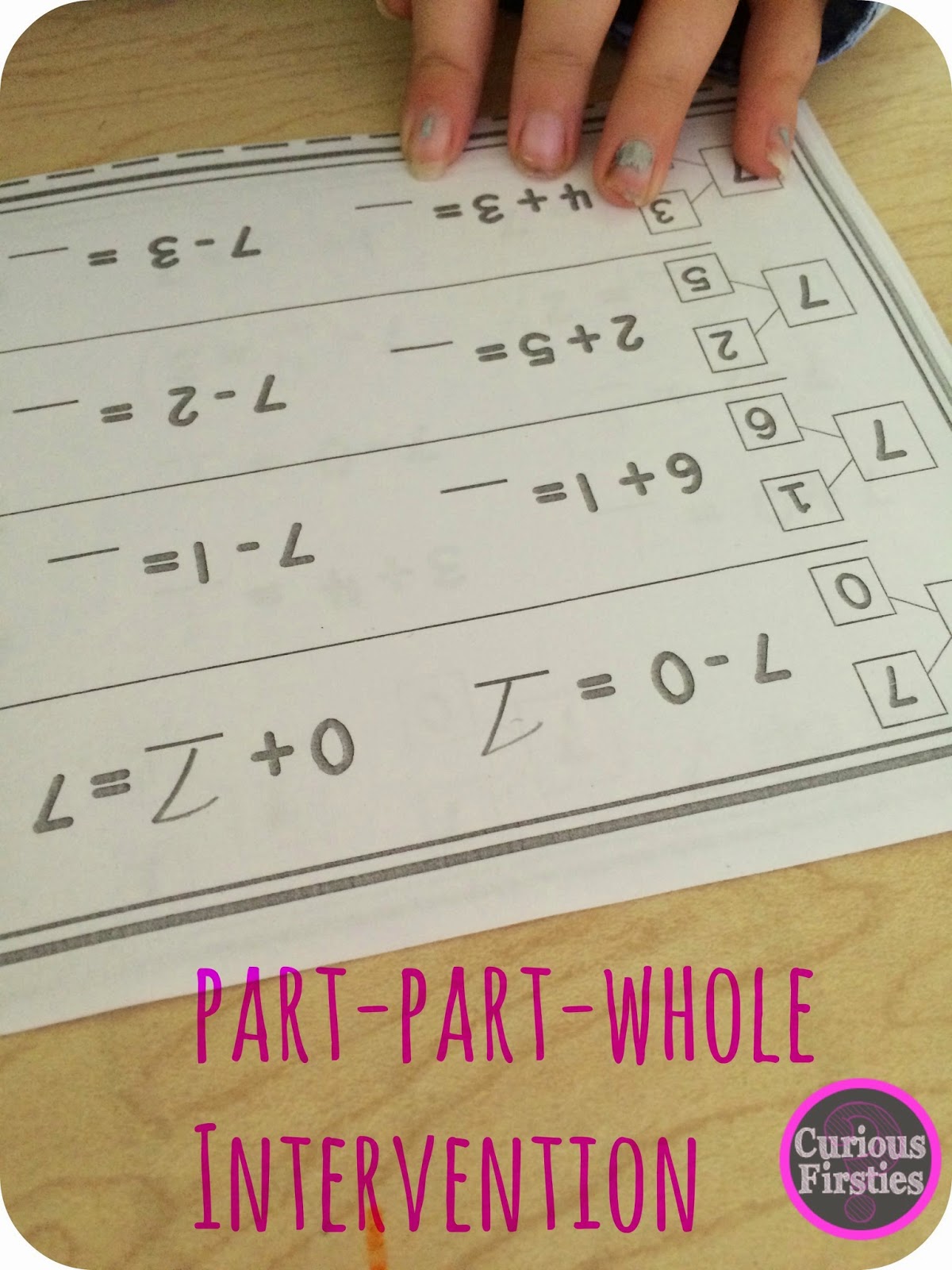
I created these intervention sheets and they have really, REALLY helped.  These half-sheets help to illustrate how the parts of a number are connected.  I think they help because it is pretty explicit and concrete for them.  There are two different types of sheets, depending on what the individual student needs.

http://www.teacherspayteachers.com/Product/Part-Part-Whole-Assessments-and-Intervention-Sheets-1520566http://www.teacherspayteachers.com/Product/Part-Part-Whole-Assessments-and-Intervention-Sheets-1520566

This routine has been working so well for our first graders.  They are feeling successful and enjoy this individual time.  For Jess and I, it is a time that we can provide differentiated, individual instruction.

We plan to continue this routine in 2015 but will continue to add components as we see the need for individual students.

If you would like to try this out with your students in 2015, it is half off right now.

http://www.teacherspayteachers.com/Product/Part-Part-Whole-Assessments-and-Intervention-Sheets-1520566 


What do you think? Is there anything we could add to this instructional time?

Connecting Addition and Subtraction

Oct 2, 2014


 How do you teach addition and subtraction?  Do you teach one first and then the other?  Do you teach them at the same time?

Not sure what the right answer is.

We have been touching on both this year and working hard to build that number sense.  But we had not been explicit about the connections between addition and subtraction.  But the time has come.

Jess and I started with this:


 We introduced the "whole-part-part" with hula hoops by asking: "What do you see?"  And guess what...?  Our number talks must be working because they replied with:
 "Oh, I see two balloons and two more balloons. 2 and 2 make 4."
"I see two small hula hoops and one big hula hoop.  2 and 1 make 3."

Yep!! We love it!!

Our lesson was ready to start!  We explained the whole number and how it can be broken into parts.

(Sorry, this example is with the whole number: 5.)
We broke the number into two parts (subtraction) and showed how we can then put the numbers back together (addition).  It was SO..MUCH..FUN!  The kids were engaged and excited to help us break apart these numbers.

We helped them transfer this learning to paper.


This lesson is the foundation for our week of addition/subtraction lessons.  Here are some activities we found (click on them for their original posts) and decided to use (with our own twists):

1. We want to make this anchor chart from "The Classroom Key" (one piece of it each day).

http://theclassroomkey.blogspot.com/2014/04/part-part-whole_9.html

Our week will start off with a review of our hula hoop activity....but with chenille sticks and beads.


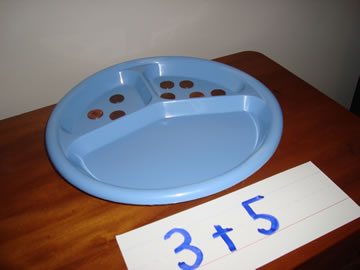
2. We want to show "whole-part-part" with plates like Dr. Jean.

http://www.drjean.org/html/monthly_act/act_2011/01_Jan_css/pg02.html

3. Just another way to show "whole-part-part" but with hangers (can't find original source.)


4. We also want to do an activity with cubes.  Each kid will have two different colors to make a part-part-whole equation.


 I think it is going to be a fun week!  But do you have any other suggestions?  We are ALWAYS looking for more ideas!!