Showing posts with label reading strategies. Show all posts

Reading Strategy: Does It Match?

Oct 1, 2016

Over the summer I read Reading Wellness:

https://www.amazon.com/Reading-Wellness-Lessons-Independence-Proficiency/dp/1625310153

Each chapter focused on one skill that would promote independence in your readers.  I loved the layout of this book because it got right down to the lesson(s) to use in order to make this happen in your classroom.  My sister and I wrote about a lesson called "Does it match?" over at the Adventures in Literacy Land.  This chapter focused on alignment when reading.  I loved the lesson when I read about it in July, but then actually DOING it....WOW!  It turned out better than I had anticipated.

The authors, Burkins and Yaris, explain that alignment must occur for readers through print and meaning.  Both must be attended to and in alignment.  The authors explain that print and meaning are comparable to a puzzle: the pieces versus the puzzle.  Which one is more important?  Both.  They are essential and important to the activity of putting a puzzle together.

Burkins and Yaris go on to say that by offering explicit strategies such as "get your mouth ready" or "look for a small word inside the big word," we are not allowing students to be decision makers or problem solvers.  They state that we are "...telling them how to solve a problem rather than supporting them in solving the problem themselves." (p71)

These statement really struck me and stuck with me as my teammate, Karen, and I prepared for our school year.  We have always taught with reading strategies like the ones described by the authors.  How do we help our new, young readers to "make it match?"

So we devised a plan...

In previous posts, I have explained that Karen and I team teach our reading strategies by modeling the strategy, asking the students to name what we do, and then asking them to illustrate it with us.  This has proven to work well for us because they are ready to practice and use those strategies during guided reading once our lessons are complete.  We wanted to do the same this year but with one little (GAME CHANGING) addition.

 We started our lesson by asking our students what body parts they use when reading.  They came up with: *eyes (to look at words and pictures)
*mouth (to say the words)
*brain (to think about the story)....we may have helped with this one.

As they came up with these body parts, I drew them on this blank puzzle.  Then I connected them with a triangle and wrote the words "Does it match?"  We explained that good readers use all three of these body parts when they read.  Then we told them that they will get stuck on words and will need to use strategies to help them solve the word but that they are always thinking "Does it match? Is what I see, what I'm saying, and what I'm thinking about the story all match?"


Once we had laid this foundation, Karen and I continued with our lessons on individual strategies.  But this year we wrote each one on a puzzle piece.  We kept reinforcing that our brain, eyes, and mouth must match in order for the story to make sense.  My goal is to use this phrase, "Does it match?" when a student needs to be prompted to solve a word while reading. 

A side note...another discovery that we made was that we also needed to start using this question during writing instruction.  Students need to make sure what they saying (or writing), what they draw (or see), and what they are thinking (about the story) all match in order for their writing to make sense.  Connection made!! Yay!!!

I can't wait to see how this change in language changes our readers!
Em

Growing Readers and Writers by Teaching with Mentor Texts

Mar 18, 2016

One of our most important goals as educators of readers is to help instill a love for reading.  Yes.  It is also to teach them how to read.  Yes.  But we also want them to understand what they are reading. And not just at a surface level, but at a deeper level.  So basically...our goal is to nurture our students into...
deep, thoughtful, fluent, "can't put the book down" readers.

Not an easy task.  But an exciting one.
And one that requires some great mentor texts that support and excite our young readers.


Last year, Tanny McGregor stopped by our classroom to present a new lesson on theme.  Within this lesson she used concrete materials, anchor charts, and discussion to help our firsties discover the theme across several texts. We were excited to put what we learned from her into place this school year.  And we knew just the books that we wanted to use.


 Ruby In Her Own Time and Leo the Late Bloomer are two texts with a similar story line.  As you can probably guess from the titles, both stories are about characters that learn to do things a bit later than their peers.  They are "late bloomers" and learn to do things "in their own time."

Ruby is a duckling that hatches later than her siblings, learns to eat late, and also learns to swim last.  But as the title states, Ruby learns to do all the things that her peers do, but at her own rate and in her own time.  Just like the little duckling, Leo learns to read, write, draw, and speak; however, he did not "bloom" until he was ready. It is interesting that the mother in both texts know that the child will "bloom" in their own time.


To begin, I want to introduce the word "theme" to my first graders because this a new term for them.  The Common Core states "retell stories, including key details, and demonstrate understanding of their central message or lesson."  The shift from the term "central message" to "theme" happens in forth grade, but I don't think it is a bad idea to expose them to both terms.


 When identifying a theme across multiple texts, Tanny called them "Text Cousins." As the lesson progresses, the possible themes are recorded on a large chart paper.  This allows students to think about all the possible themes based on evidence from all three texts.


 To begin our study of central message, I will display a quote from Gandhi.  I will read it, we will read it, and they will read it.

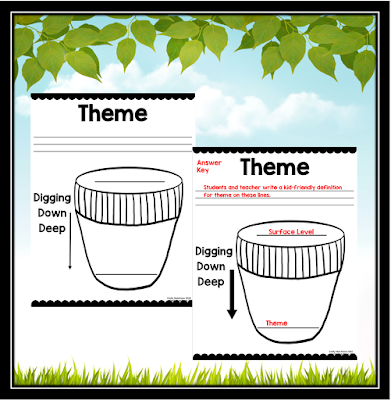
The students can then identify surface level information about this quote such as: 16 words, 2 contractions, or 2 sentences.  As these surface level items are discussed the students will get to touch the surface of the sand in my glass bowl.

Side note: I am using "moon sand" for this lesson because I like the way it moves when we dig deeper for the theme.

After students explore all their surface level thinking with the quote, I want them to begin thinking about what Gandhi really means by this quote.  What is his message to us?  (As I ask this question, I am going to dig deeper in the glass bowl.)


As students share their thinking in this lesson, I will keep track of these theme ideas on our chart paper; however, students will also get to dig deeper into our bowl and place a "digging deep: theme" card at the bottom of the bowl.

We will continue our discussion of digging deeper into the theme with the book Leo the Late Bloomer; however, I will only be showing the illustrations from this text and talking with students about what they see going on in the story.  I want them to focus on the overriding theme and message from the author through the illustrations.  Once the picture walk is complete, students will add their theme ideas to our chart (while also digging deeper into our bowl).

The final book, Ruby in Her Own Time, will then be read aloud in its entirety.  Students will "turn and talk" to decide what they think the possible theme could be across all these texts.  As we record these theme ideas, I will be asking what evidence led them to that conclusion.


This lesson can be used with any texts that fit the needs of your students.  Within this resource, you will find the quote from Gandhi typed up in case you would like to use these specific "text cousins: (as Tanny called them).  Along with the quote, there are surface level and digging deep cards.

https://drive.google.com/file/d/0B3eyEJCd5J5kdndabUdqSURhNm8/view?usp=sharing


The surface level/deeper thinking cards can be used as an additional visual when the students touch the surface of the sand or dig deeper into the bowl.  I would like them to not only see the surface of the sand but also SEE where their thinking would fall in this bowl.  Then when they have deeper thought, I want them to not only dig, but place a thinking card.


Two graphic organizers are included to assist your students understanding of surface versus deeper thinking.  The first organizer is more of a labeling activity to help them show you what they learned from the lesson.

https://drive.google.com/file/d/0B3eyEJCd5J5kdndabUdqSURhNm8/view?usp=sharing

The second organizer requires students to determine the theme of a text and provide support for their thinking.  This could be used in a whole group, small group, or independently.

https://drive.google.com/file/d/0B3eyEJCd5J5kdndabUdqSURhNm8/view?usp=sharing


https://drive.google.com/file/d/0B3eyEJCd5J5kdndabUdqSURhNm8/view?usp=sharingI hope that this is a lesson that you can use with your students this year. Be sure to grab your Freebie by clicking on any of the product images!  Please let me know if you have any suggestions or questions about this lesson on theme.  Thanks!

 Before you move on to the next post, my mystery word is Butterflies. [HERE] is the link to the form you can use to keep track of the mystery words at each stop. You'll need them for an entry on the Kindergarten-2nd grade Rafflecopter below.


a Rafflecopter giveaway


And We're Off

Sep 5, 2014


Testing is done...well except for those Aimsweb tests that will be completed by a team of retired teachers.  CHAMPs expectations and procedures have been taught and practiced.  Switching classes has been implemented.  And this was the first week of a normal schedule (minus fire drills, Labor Day, and a Puppy Den vertical meeting.)  Okay...we will call it a normal-ish schedule.  Our firsties did a great job switching classes for the first time and we had a lot of fun setting up some of the concepts that we want to hit hard this year.

Last year I mentioned that we had read "Smarter Charts" by Martinelli and Mraz.  It played a role in how we presented our reading strategies, math strategies, rules, and other charts throughout the year.  Reflecting back now, I can see the impact that it really did make on our students last year.  They did not just refer to the reading strategy posters hanging up...they really took ownership over them.  The math strategies...they knew them!  I could really see the big difference that some of our small changes made.

So we did it again.

First of all, you must know, I have used the same reading strategy posters for many, many, many years. (This was before my discovery of TPT and all things pretty.)  They looked like this:


 They got the job done.  The strategy was listed and there was a picture clue to help the kids out.  I had these as small posters hanging up, sheets for them to keep in their desks, bookmarks were made for them to take home, and parent sheets were printed and sent home.  They got the job done.

But (as I mentioned) Karen and I decided to change.  We wanted the kids to own these strategies more.  We wanted them to feel like THEY came up with them.  So that is what we did.

I stood in front of those little firsties and told them that they WILL get stuck on words this year.  I reassured them that our room is a safe place and that as learners, we have to get stuck.  Because when we get stuck, we learn how to get unstuck.  I explained that Karen and I get stuck on words all the time and our brains have strategies to solve the problem.  But we needed their help to write these strategies down so that we can all use them.

And we're off...they are hooked and ready to help.

Karen sat at the document camera with her very loved Curious George book.


She read and we watched.  We listened.  When she got stuck, we were quiet and examined what she did to solve the problem.  Once the problem was solved, our firsties helped to name that strategy.  It took some encouraging but they got it.  After the strategy had a name, we needed a picture.  They came up with this too.  Here is what the first one looked like:


 We continued with this same routine for each strategy that we wanted to hit.  It took about 2 1/2 sessions for all the strategies to be complete.  But it was worth it!  The kids were making connections between the strategies and talking about how some can be used at the same time.

Now what? Well...I have to make them look a tad bit prettier.  That is my weekend job.  I've started...


I hope we see the same type of results that we did last year.
How do you teach your reading strategies?


Wednesday WOW linky party

Sep 18, 2013


Last week was the full on start to our guided reading groups.  Woot Woot!  No more practicing, going over procedures...it is on!  So this is the topic of my Wednesday WOW!  Hope you can link up with something great in your classroom (or personal life).


So my plans were nicely laid out, books were retrieved, and materials on hand.  And it went well!  Actually, they mastered the books that I picked out for them.  So one of my groups got an extra book on Friday.  I did not have a lot of time to search for the perfect book Friday morning, so I did my best and ended up with a book called "Carrots."
 It was a Level B book and basically went like this "I plant the seeds in my garden.  I water the seeds in my garden......I slice the carrots in my kitchen."
My reading strategy focus this week was "Look at the pictures" and "Get your mouth ready for the first sounds." (These are our little strategy cards that we made together.)

 This book ended up being a perfect fit to practice these two strategies!  It was one of those WOW moments because I couldn't believe that a book I picked up quickly worked out so well for what I needed.  I was thrilled and they actually really enjoyed this book about carrots.  Who would have known :)


Let up know what went well for you this week! Link up below.


LInky Party---Wednesday WOW!

Sep 11, 2013


 Link up to share something that went unexpectedly well for you this week (personal or professional).  After you write up your post, be sure to link up below.  You can use the image above in your post and please link back to this post on your blog.
------------------------------------------------------------------------

Each year I introduce the reading strategies that I would like my students to use when they get stuck on a word.  Typically, I do this in guided reading groups.  I have always used images to help me:

But this summer I read Smarter Charts.
This led to an idea of coming up with the reading strategies as a class.  Karen and I decided that she would read a book aloud and would use reading strategies when she got stuck on a word.  Then I asked our firsties to verbalize what she did to figure out the word.  I wrote their words down on a note card and we brainstormed an image that would help their brain remember that strategy.

Oh My!! I was not sure how this would go because it was going to occur whole group.  What if they can't verbalize what she is doing?  What if they don't describe an image that will really help them to remember the strategy?

It went so well!  I was thrilled that the idea worked.  We discussed why these strategies important (because I am not going to live with them as adults...so they need to learn to read without my help!)

I also have a smaller version with magnets on the back.  We use them to point out specifically what we hear each other doing when we read in our groups.

I can't wait to hear about all of your great happenings this week!