Showing posts with label linky. Show all posts

Growing Readers and Writers by Teaching with Mentor Texts

Mar 18, 2016

One of our most important goals as educators of readers is to help instill a love for reading.  Yes.  It is also to teach them how to read.  Yes.  But we also want them to understand what they are reading. And not just at a surface level, but at a deeper level.  So basically...our goal is to nurture our students into...
deep, thoughtful, fluent, "can't put the book down" readers.

Not an easy task.  But an exciting one.
And one that requires some great mentor texts that support and excite our young readers.


Last year, Tanny McGregor stopped by our classroom to present a new lesson on theme.  Within this lesson she used concrete materials, anchor charts, and discussion to help our firsties discover the theme across several texts. We were excited to put what we learned from her into place this school year.  And we knew just the books that we wanted to use.


 Ruby In Her Own Time and Leo the Late Bloomer are two texts with a similar story line.  As you can probably guess from the titles, both stories are about characters that learn to do things a bit later than their peers.  They are "late bloomers" and learn to do things "in their own time."

Ruby is a duckling that hatches later than her siblings, learns to eat late, and also learns to swim last.  But as the title states, Ruby learns to do all the things that her peers do, but at her own rate and in her own time.  Just like the little duckling, Leo learns to read, write, draw, and speak; however, he did not "bloom" until he was ready. It is interesting that the mother in both texts know that the child will "bloom" in their own time.


To begin, I want to introduce the word "theme" to my first graders because this a new term for them.  The Common Core states "retell stories, including key details, and demonstrate understanding of their central message or lesson."  The shift from the term "central message" to "theme" happens in forth grade, but I don't think it is a bad idea to expose them to both terms.


 When identifying a theme across multiple texts, Tanny called them "Text Cousins." As the lesson progresses, the possible themes are recorded on a large chart paper.  This allows students to think about all the possible themes based on evidence from all three texts.


 To begin our study of central message, I will display a quote from Gandhi.  I will read it, we will read it, and they will read it.

The students can then identify surface level information about this quote such as: 16 words, 2 contractions, or 2 sentences.  As these surface level items are discussed the students will get to touch the surface of the sand in my glass bowl.

Side note: I am using "moon sand" for this lesson because I like the way it moves when we dig deeper for the theme.

After students explore all their surface level thinking with the quote, I want them to begin thinking about what Gandhi really means by this quote.  What is his message to us?  (As I ask this question, I am going to dig deeper in the glass bowl.)


As students share their thinking in this lesson, I will keep track of these theme ideas on our chart paper; however, students will also get to dig deeper into our bowl and place a "digging deep: theme" card at the bottom of the bowl.

We will continue our discussion of digging deeper into the theme with the book Leo the Late Bloomer; however, I will only be showing the illustrations from this text and talking with students about what they see going on in the story.  I want them to focus on the overriding theme and message from the author through the illustrations.  Once the picture walk is complete, students will add their theme ideas to our chart (while also digging deeper into our bowl).

The final book, Ruby in Her Own Time, will then be read aloud in its entirety.  Students will "turn and talk" to decide what they think the possible theme could be across all these texts.  As we record these theme ideas, I will be asking what evidence led them to that conclusion.


This lesson can be used with any texts that fit the needs of your students.  Within this resource, you will find the quote from Gandhi typed up in case you would like to use these specific "text cousins: (as Tanny called them).  Along with the quote, there are surface level and digging deep cards.

https://drive.google.com/file/d/0B3eyEJCd5J5kdndabUdqSURhNm8/view?usp=sharing


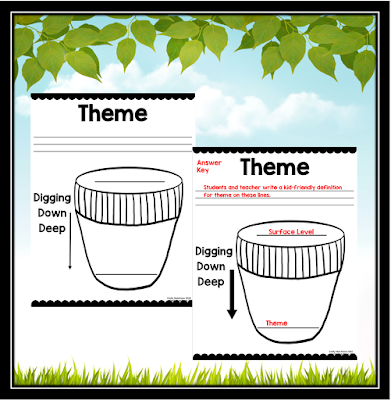
The surface level/deeper thinking cards can be used as an additional visual when the students touch the surface of the sand or dig deeper into the bowl.  I would like them to not only see the surface of the sand but also SEE where their thinking would fall in this bowl.  Then when they have deeper thought, I want them to not only dig, but place a thinking card.


Two graphic organizers are included to assist your students understanding of surface versus deeper thinking.  The first organizer is more of a labeling activity to help them show you what they learned from the lesson.
https://drive.google.com/file/d/0B3eyEJCd5J5kdndabUdqSURhNm8/view?usp=sharing

The second organizer requires students to determine the theme of a text and provide support for their thinking.  This could be used in a whole group, small group, or independently.

https://drive.google.com/file/d/0B3eyEJCd5J5kdndabUdqSURhNm8/view?usp=sharing


https://drive.google.com/file/d/0B3eyEJCd5J5kdndabUdqSURhNm8/view?usp=sharingI hope that this is a lesson that you can use with your students this year. Be sure to grab your Freebie by clicking on any of the product images!  Please let me know if you have any suggestions or questions about this lesson on theme.  Thanks!

 Before you move on to the next post, my mystery word is Butterflies. [HERE] is the link to the form you can use to keep track of the mystery words at each stop. You'll need them for an entry on the Kindergarten-2nd grade Rafflecopter below.



a Rafflecopter giveaway


Sunday Scoop

Feb 28, 2016


 What a week ahead!  Leap Day and Read Across America...good to think ahead.  Linking up with the Teaching Trio for a Sunday Scoop.


Sunday Scoop

Jan 17, 2016


Snow is falling.  The fingers are freezing (well...they always are) and I am wearing a cozy sweater.  Seemed like a good day for a Sunday Scoop.


Reading in Winter Wonderland

Nov 27, 2015


Hello and welcome to our second annual Winter Wonderland link up!  Last year, The Reading Crew sponsored a winter literacy hop, but we decided to run it a little different this time. Instead of hopping with the potential of dead links, we decided on a closed link up. What this means is that there is a "map" of the blogs at the bottom of each post, so you can hop through them all at once, visit some today and some later in the week, or see what best matches your literacy needs. 

On each blog, you will see a word in blue font. This is the blog's mystery word. Please be sure to record them because you will need each word for a five point entry in our raffle. To help you keep track, you can print and use the form below.

 
 We are raffling off two wonderful prizes. We are giving away a copy of each book featured in our posts to two winners (K-2 group) and the (3-up group). Each prize package will include 12 books (K-2) and 13 books (3-up). 

On each blog, we will be sharing a mentor text lesson using the book we've chosen. The lesson will be modeling a reading skill (comprehension or writing typically, but some at the primary level may target vocabulary, fluency, or word building).  The materials that are shared may be forever freebies or may be free for a limited time. Please take note of this as you visit the blogs. 

Again, we welcome you to our blogs and wish you and yours a wonderful holiday season.

Trees are one of my favorite things about the season.  The smell of pine, the lights, and the beautiful shades of green.  Living in the Midwest, winter time equates to not a lot of color.  Lots of grays, browns, and white snow. (I do love the white snow!)  But the pine trees still give off their color.

When I found this book quite a few years back, I instantly fell in love with it because it is filled with trees of all sizes. 
Mr. Willowby has his tree delivered but he quickly finds out that it is too tall. So the butler cuts off the top and gives it to the maid.  This tree is too big for the maid and she must chop off the top.  The gardener picks this little treetop up but has the same problem.  And so the story continues through many different characters but the final piece of the tree ends up back at Mr. Willowby's home with a little family of mice.

 The book is filled with great oral vocabulary for our youngsters. Some of the words that stick out to me include: glistening, dashed, splendid, magnificent, haste, delighted, snipped, padding, drowsily, hunk, trim, scampered, frolicking, and nook.  Here are two of my favorites in use.  Oh!  And did I mention that this is a rhyming book, as well?


Before introducing the book I like to get an idea of the prior knowledge students have with the vocabulary words.  I ask them to put a thumbs up for "I know it," a thumbs down for "I've never heard it," and a sideways thumb for "I've heard it but don't know what it means."  This is just a little pretest for me and them because now they know what to listen for as I read the text.
Once I begin reading, I will quickly pause at the six vocabulary words that I have chosen to focus on for the week.  I give a very quick and brief definition.  Sometimes it can be a one word definition.  The example below shows how I would read this page to emphasize the word "scampered."


My lesson has two primary focuses.  I want students to have an understanding of the vocabulary words that I have chosen to point out because I think that they are rich and meaningful to the story.  If they do not understand them, it will impact their comprehension of the story.

But I also want them to be able to retell the story.  This can be done as a whole class and then it can be done independently through a sequencing activity.

This freebie includes three versions of the sequencing activity.  Each version includes the same events but the difficulty of the text changes. See the example of one sentence below:

I like when the students sequence the sentences on construction paper.  This allows for more space to move the sentences around. Once they are in place, students can glue them down.

Since oral vocabulary is learned through repeated exposure, I spend the week quickly reviewing and using the words that were first introduced through Mr. Willowby's Christmas Tree.  With this repeated exposure and usage, the hope is that the words will become part of the oral vocabulary of the students too.  Some things that I do to build this understanding is providing kid friendly definitions, giving examples and non-examples of the words, showing images, or asking the students to draw quick sketches of the vocab words.  
Oral vocabulary has been one of my personal focuses this year because I really saw a gap in my teaching.  At the end of the week I have been assessing the receptive and expressive vocabulary of my students to determine if my teaching routine for vocabulary is effective.  I have included the assessment in this freebie.  You can use it with any vocabulary words from Mr. Willowby's Christmas Tree or any other book throughout your school year.


Tip:  When I first started using this assessment, my team and I did not include that many words.  We would white out what we did not need.  We also gave the students strips of words typed up.  They would just glue the words down instead of writing them.  This was helpful to us as we all got use to the assessment.  And....we like to throw in some review words!

This is a forever FREEBIE.  Please click on the cover below to grab your copy!

https://drive.google.com/file/d/0B3eyEJCd5J5kUG5iRVJPNXZxajA/view?usp=sharing

Before you go, I will remind you that my mystery word is tree. You can enter it onto your sheet or into the rafflecopter below. Good luck to you, and I hope you'll come back soon.

 
Pin for Later:


What I've Learned From Teaching

Jul 7, 2015

Summer is such a great time for link ups!  Today I am linking up with My Day in K and Teach, Talk, Inspire.

Today is the Top Ten things that I have learned from teaching.  This was not an easy task and I am not convinced that even like what I came up with.

I LOVE LOVE LOVE chocolate.  But I especially NEED NEED NEED chocolate after a busy morning and a learning-filled afternoon!  Let's face it...I need chocolate at all points in my day.

I can never have enough Post-its.  They are all over my teaching binder, guided reading table, guided math table, countertop at home...all over!  I am an old fashioned list girl and I need Post its to do it!

My first two years of teaching I saved my plan book and thought that I would look back.  Nope.  Every year brings its own set of kids, challenges, and lessons.  That is why I love this career so very much.
It is hard.  Not necessarily in a bad way.  And I don't think you realize how very hard and challenging it can be until you are in that classroom on your own.
I am pretty sure that every teacher knows what this means. So  many things are going on at one time in a classroom and things can change or not work (technology) in a split second.  Teaching has taught me to think fast.

As each challenge arises, I learn from it.  Whether it is from a student, in a professional book, from a colleague, or in a blog post that I read, each day bring new learning for me.
Never.  Ever. Whether I am at Target, on the playground with my kids, or eating dinner my teacher brain is always on.
I am not quite sure how to be a teacher without multi-tasking.  So many things have to be done in one single moment.  You learn very quickly that you must multi-task to make it through a day.

Yes, I am there to impart knowledge on this wonderful little kiddos.  But when it come down to it...my kids need a smile each morning and love.  This is what will stick with them the most.

The one thing I know for certain...I will never know everything about teaching.  My to-do list of learning will never end.  And if I ever do feel that I know everything, it is time for me to leave this wonderful career.


Fun with Phonemic Awareness

Jun 24, 2015

I have really come to enjoy teaching phonemic awareness.  It provides such an opportunity to be silly with the kids!  Since I primarily teach reading in small groups, phonemic awareness is a quick part of our daily routine.  For the past few years I have really been into the fractured nursery rhymes (is that what you would call them?)  They are poems that go to the tune of the nursery rhyme but may have some different verses.

My firsties think they are so funny!!  And are always asking for more.  I even try to get them to make up new ones as a group.  

I use these rhymes in so many different ways depending on what they group needs.  It may be rhyming or maybe onset/rime or maybe segmenting sounds.  But I use these rhymes as the tool to hit any of those skills.

These are some of my favorite nursery rhyme books right now.

 Do you have any favorite nursery rhyme books that you can suggest?
Please link up below with your fun Phonemic Awareness or Phonics ideas.